Raymond Briggs’s unsparing animated anti-war film When the Wind Blows turns 40 this week, and its handmade approach still feels radical. The 1986 adaptation of his 1982 graphic novel is not a typical animation: it is a hybrid of traditional and stop-motion craft, built to make nuclear dread feel domestic. Here are the facts behind it.
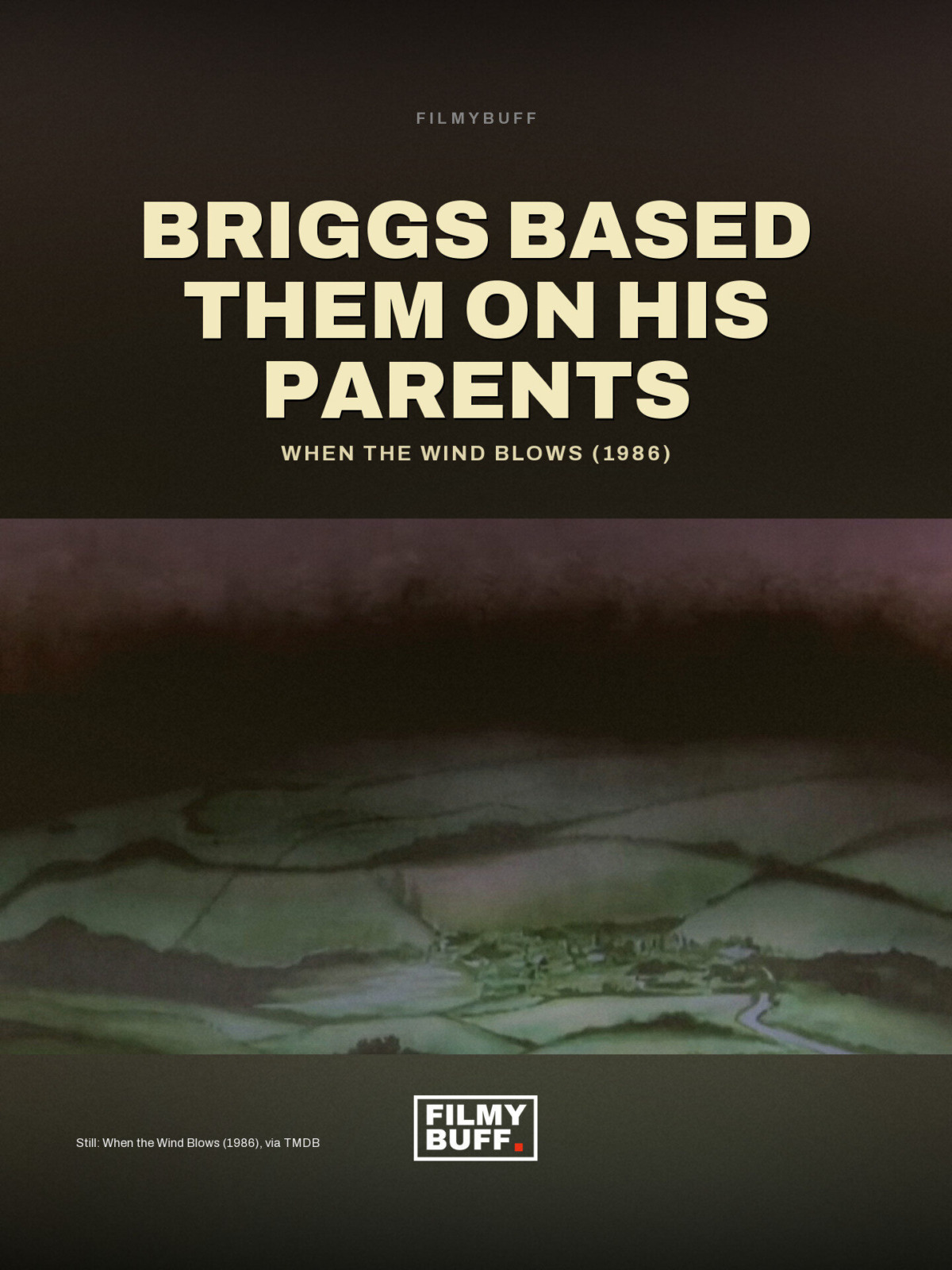
The couple came from Briggs’s own parents
A subsequent graphic novel by Raymond Briggs, Ethel and Ernest (1998), makes it clear that he based the protagonist couple in When the Wind Blows on his own parents. The film itself is a 1986 British adult animated anti-war film directed by Jimmy Murakami, based on Briggs’s 1982 graphic novel. It stars the voices of John Mills and Peggy Ashcroft and was scored by Roger Waters.
It began after The Snowman
When the Wind Blows was Briggs’ second collaboration with TVC, after they worked on a special based on The Snowman in 1982. The film recounts an elderly couple’s attempt to survive a nuclear attack and maintain a sense of normality in fallout and nuclear winter.
The characters are drawn, the house is real
The film is a hybrid of traditional and stop-motion animation. Jim and Hilda Bloggs are hand-drawn, as is the area outside their house, but their home and most of the objects in it are real objects that seldom move and are animated with stop motion when they do.
The rooms copy Protect and Survive
The stop motion environments are based on the style used for the Protect and Survive public information films. In the story, Jim follows instructions outlined in the government-issued Protect and Survive pamphlets to build a fallout shelter.
David Bowie almost scored more of it
Originally, David Bowie was supposed to contribute several songs to the soundtrack, but he pulled out so he could focus on his upcoming album Never Let Me Down. Instead he only submitted the title track, and Roger Waters was brought in to complete the project.
The soundtrack became a who’s who
The soundtrack album features music by David Bowie, Roger Waters, Genesis, Squeeze, Hugh Cornwell and Paul Hardcastle. David Bowie performed the title song.
A tiny US theatrical run
When the Wind Blows was distributed by Recorded Releasing in the UK, and by Kings Road Entertainment in the United States. Its US theatrical run was short; in one theatre, it grossed $5,274 at the box office in 1988.
Home video kept it alive
The film was released on VHS in the United Kingdom by CBS/Fox Video after its theatrical run, and later on laserdisc. In the United States, it was released on VHS by International Video Entertainment and on laserdisc by Image Entertainment. It was released on DVD in 2005 by Channel 4, with 0 region coding; the official UK DVD is still PAL format.
The limited Blu-ray collectors want
In the United States, Twilight Time released a Blu-ray on 11 November 2014 in a limited edition of 3000. Severin Films later released another Blu-ray and a DVD through their Severin Kids label on 21 April 2020.
Which of these handmade details surprised you most? Tell us the fact you’ll be thinking about on your next rewatch.
Facts from Wikipedia: When the Wind Blows (1986 film), available under CC BY-SA 4.0.
Film images from TMDB. This product uses the TMDB API but is not endorsed or certified by TMDB.