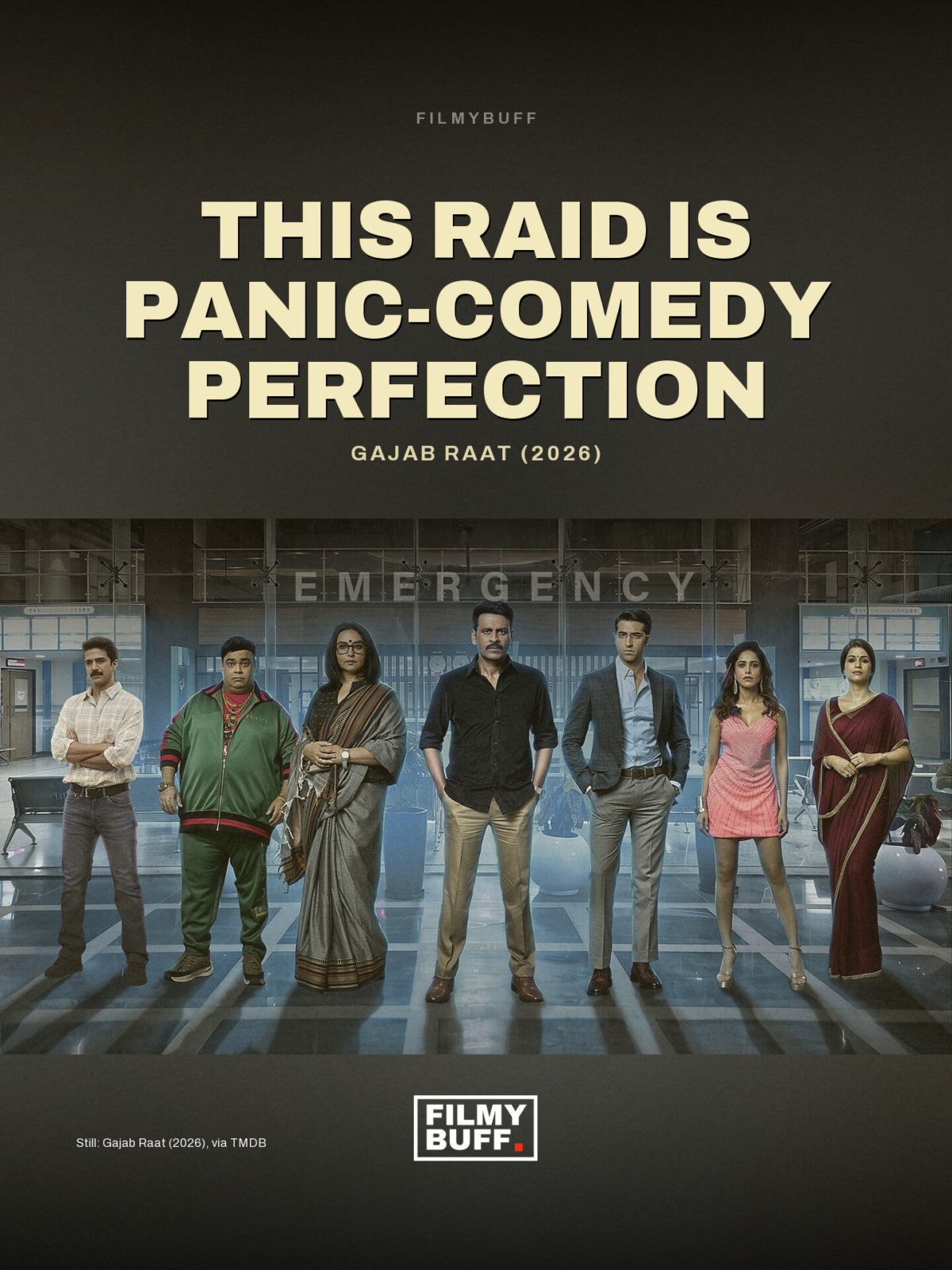
I have rewound this raid three times, and the third watch is the one where the craft shows.
1. The setup: where the scene sits in the film and what is at stake
By this point, the hotel has already been established as a place where every door opens one beat too early. Manoj Bajpayee’s character has worked too hard to keep a small operation invisible; Nushrratt Bharuccha’s character needs him not to find her there; Kiku Sharda is the loose end wearing a waiter’s jacket. What is at stake is not just getting caught—it is who gets caught first and who has to explain the other.
2. The turn: the beat where the scene changes gear, and how the film gets there
The scene starts on tiptoe: a corridor, a key card, the low murmur of a hotel that does not know it is about to become a crime scene. The gear change arrives when the raid announcement cuts through the lobby music. The film does not speed up the editing; it tightens the frame, trapping the three of them in the same narrow slice of hallway. From that moment, the scene stops being a close call and becomes a group problem.
3. The line: the line or the moment people quote, and why it lands
The quotable moment is less a one-liner than Nushrratt’s strangled “Aap?” when the door opens. It lands because it is not a scream—it is a reflex, the sound of a lie losing its cover before her character can find a better one. Manoj’s reply is half a beat late, so the silence between them does the comedy that a bigger line would have thrown away.
4. The performance: what the actor or actors do, precisely, that a lesser scene would not
Manoj Bajpayee plays it from the shoulders up: the jaw first, then the eyes, then the hands. His panic is not cartoonish; it is a man trying to be polite while his entire night collapses. Nushrratt Bharuccha does the reverse—her body reacts before her face, so she is already stepping sideways while she is still smiling. Kiku Sharda keeps his panic in his feet, always one stumble behind the action, which is exactly why he steals it.
5. The craft: the staging, the cut, the music, the sound, the camera, whichever carries it, with one specific choice named for each you mention
The staging blocks them as three wrong turns: Manoj by the door, Nushrratt behind the suitcase, Kiku in the gap between the cart and the wall. The cut matters most when the raid is announced—the editor holds on Kiku for an extra half-second before cutting away, so his reaction becomes the scene’s first laugh. The sound design pushes the corridor ambience up just enough to make the silence before Manoj’s reply feel even louder. The camera keeps dropping to the shoes, a choice that turns the hallway into a dance floor nobody asked for.
6. Why it travels: why this scene is the one people share, decades or days later
It travels because the joke does not depend on knowing the whole film. Anyone who has ever tried to leave a room at the wrong moment understands the mathematics of this scene: three people, two exits, one very small lie. Manoj Bajpayee and Nushrratt Bharuccha give it the face, but Kiku gives it the feet—and that is the part people send to group chats.
Watch the original: Netflix India on YouTube. Shown for review and comment; the rights stay with the makers.