For people who love the movies, some films don’t age so much as they keep returning. As Maachis turns 30 this week and Gulzar’s comments about the film reflecting the truth of extremism are in the news, it’s the right moment to revisit the details that make this 1996 film land. Here are eight things you may not know about Gulzar’s Maachis.
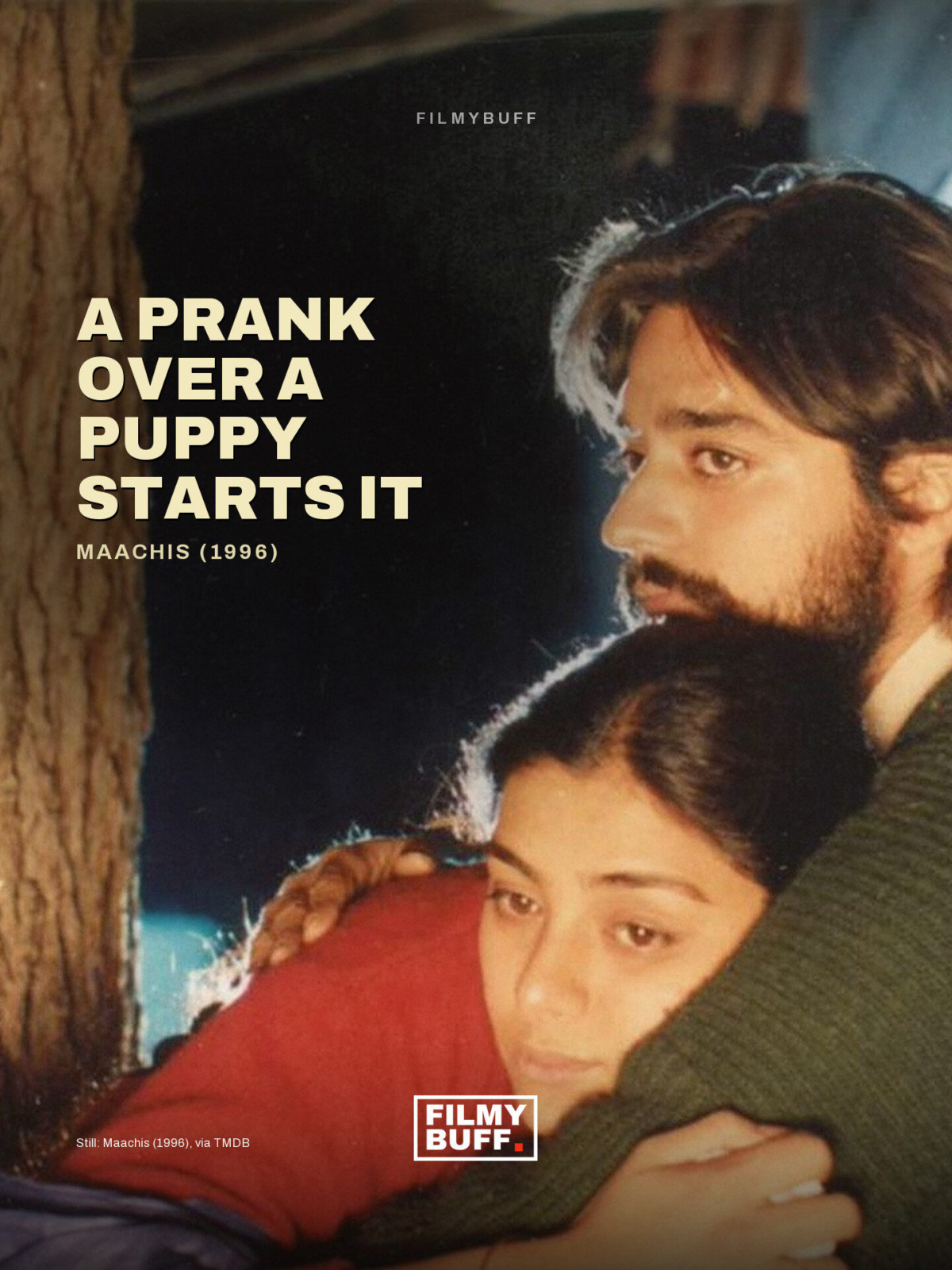
A prank over a puppy named Jimmy starts it
The story is set during the mid-to-late 1980s in Punjab, India, a period marked by violent insurgency triggered by Operation Blue Star, the assassination of Prime Minister Indira Gandhi, and the subsequent 1984 Sikh Massacre. Police arrive in Jaswant Singh Randhawa’s village looking for Jimmy, who is accused of attempting to murder a member of the Indian Parliament, Kedar Nath. Jaswant plays a prank by leading them to his puppy, Jimmy. Infuriated by his defiance, Khurana and Vohra take Jaswant into custody.
Jaswant comes home after 15 days, tortured
Kripal desperately searches for Jaswant, visiting several police stations but finding no trace of him. After 15 days, Jaswant returns home, severely beaten and scarred from brutal police torture, all for a harmless prank. The moment turns the story from mischief into trauma.
The legal route offers no justice
Kripal, outraged by the police brutality, seeks help through legal channels but finds no justice. Frustrated, he decides to track down his cousin Jeetay, who is connected to militant groups. That decision carries the film beyond the law.
A dhabha meeting leads to a bomb truck
Kripal’s search leads him to a highway restaurant, or dhabha, where he encounters Sanatan, a militant who had planted a bomb on a bus. Sanatan reluctantly agrees, allowing Kripal to travel with him, a “Commander,” and other militants in a truck loaded with bombs. The journey sets Kripal on a path he cannot easily leave.
The Commander already killed his cousin Jeetay
Once they arrive at the militant hideout, the Commander reveals that he killed Jeetay for being a police informant. Despite Kripal’s plea for assistance, the Commander rebukes him: they are not professional killers, and if Kripal wants justice, he must kill Khurana by himself. It is a chilling threshold, not a rescue.
Sanatan reframes the fight as civil rights, not religion
Sanatan explains that Kripal’s fight is not about nationalism or religion, but about defending fundamental civil rights and resisting a corrupt system that victimizes the innocent and devalues ordinary citizens. That line of reasoning gives the film its political sharpness.
Sanatan carries wounds from Partition and 1984
It is revealed that Sanatan himself is a survivor of the communal violence during the Partition of India in 1947 and lost most of his family in the 1984 anti-Sikh riots. He asserts that the ruling class manipulates society by dividing it along religious lines for political gain. His past becomes the film’s explanation of how ordinary people are pushed toward extremism.
Maachis released a week late
Maachis was originally scheduled to be released on October 18, 1996, but its release was delayed by a week to 25 October 1996. The score and soundtrack were composed by Vishal Bhardwaj, with lyrics written by Gulzar; the album also includes several background score pieces from the film.
Which of these details changes how you remember Maachis? Tell us your favourite fact.
Facts from Wikipedia: Maachis, available under CC BY-SA 4.0.
Film images from TMDB. This product uses the TMDB API but is not endorsed or certified by TMDB.