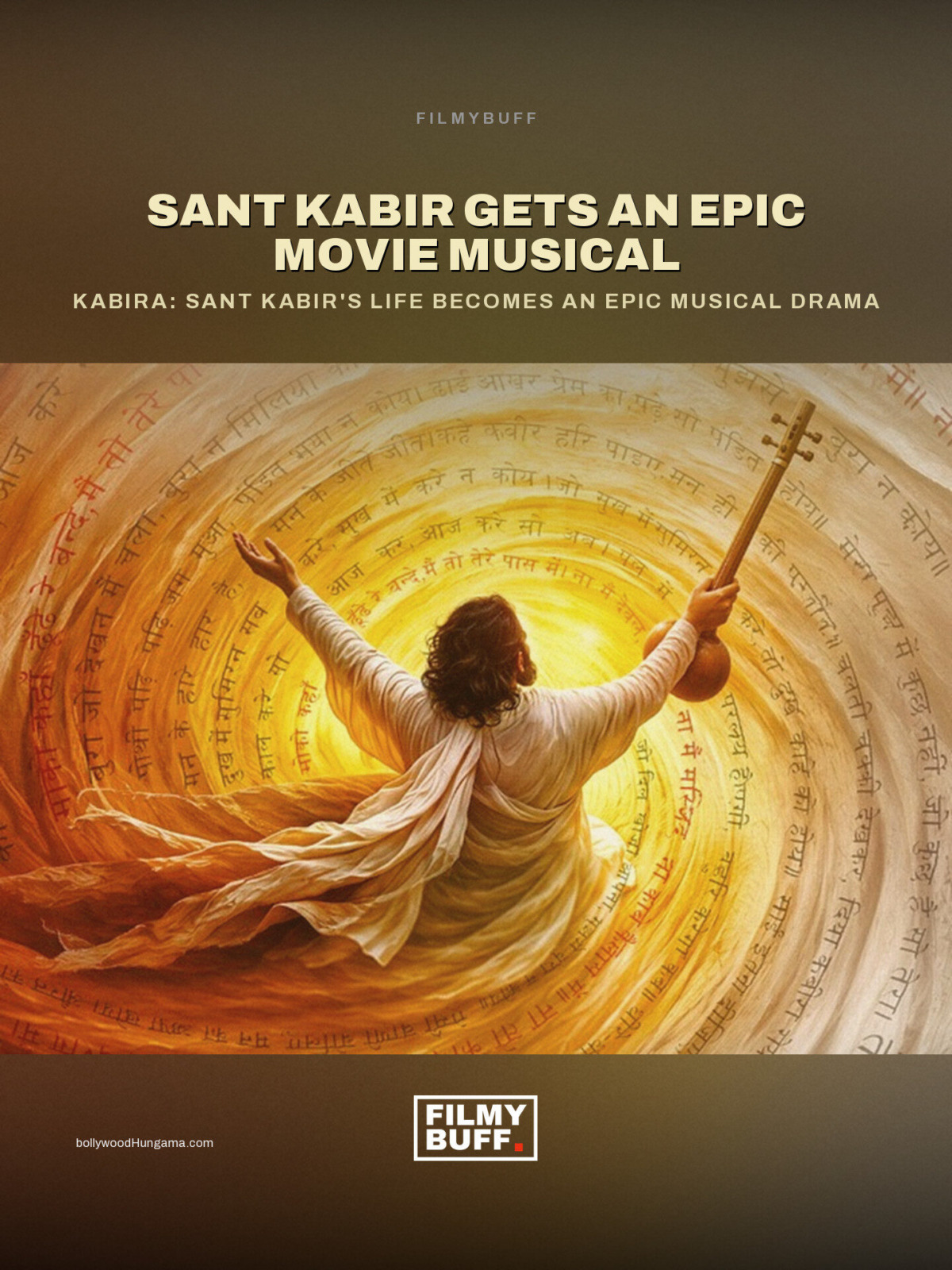
Mahaveer Jain Films has announced Kabira, an epic musical drama built around the life and philosophy of Sant Kabir. The film will travel back to 15th-century Kashi and try to turn the poet-saint’s verses into a theatrical experience rather than a history lesson.
What the film will explore
Kabir’s story sits outside tidy boxes. He was born to a Hindu mother and raised by a Muslim weaver family, and his poetry challenged caste divisions, religious orthodoxy and the walls communities build between themselves. Those contradictions are exactly the material a strong bio-drama needs.
Kabir wrote in dohas, short paired lines that people still quote, sing and share today. The film will reframe those lines through folk, Sufi and classical fusion sounds, with Kashi’s ghats and cultural atmosphere as the backdrop.
The team so far
Abhishek Sharma, best known for Parmanu: The Story of Pokhran and Tere Bin Laden, will direct, while Tanishk Bagchi takes charge of the music. The principal cast has not been revealed, which is slightly unusual for a project of this scale and suggests the producers are treating the sound and the story as the lead characters.
- Director: Abhishek Sharma
- Music: Tanishk Bagchi
- Presenters: Mahaveer Jain and Amit Upadhyay
- Producers: Mahaveer Jain Films, Saral Vallabh Bhansali and Shraddha Singh
- Banner: A Shock and Awe Production
- Shoot: Early 2027
The production is billed as a musical experience for theatres, not a quiet streaming drop. That matters because Kabir’s dohas already have organic reach: they are quoted in classrooms, social media and devotional spaces. The film’s job is to give them a story shape that justifies the big screen.
Why this is worth watching
Indian movie musicals usually present songs as album items. Kabira appears to be reversing that logic. The music is being announced as the creative spine, with the composer named alongside the director before any actor. That is a small but telling signal that the film will be built around sound and mood rather than a star’s familiar image.
The director’s earlier work carries a wide range, from the satirical Tere Bin Laden to the nationalistic Parmanu. Here the challenge is different: a devotional subject that needs emotion without turning static. Sharma will have to balance scale with the spareness of Kabir’s verses.
For viewers, the practical takeaway is simple. Revisit the dohas now. The familiar lines are going to be re-orchestrated, and the film will hit harder if you can hear what changed under Bagchi’s arrangement. There is no cast yet, so expectations should stay anchored on the craft team. When the lead is finally named, it will tell us whether the makers are chasing reach or protecting the film’s tone.
For now, the promise is specific: a 15th-century voice, a Kashi setting, and a composer who knows how to make old poetry sound like an event.