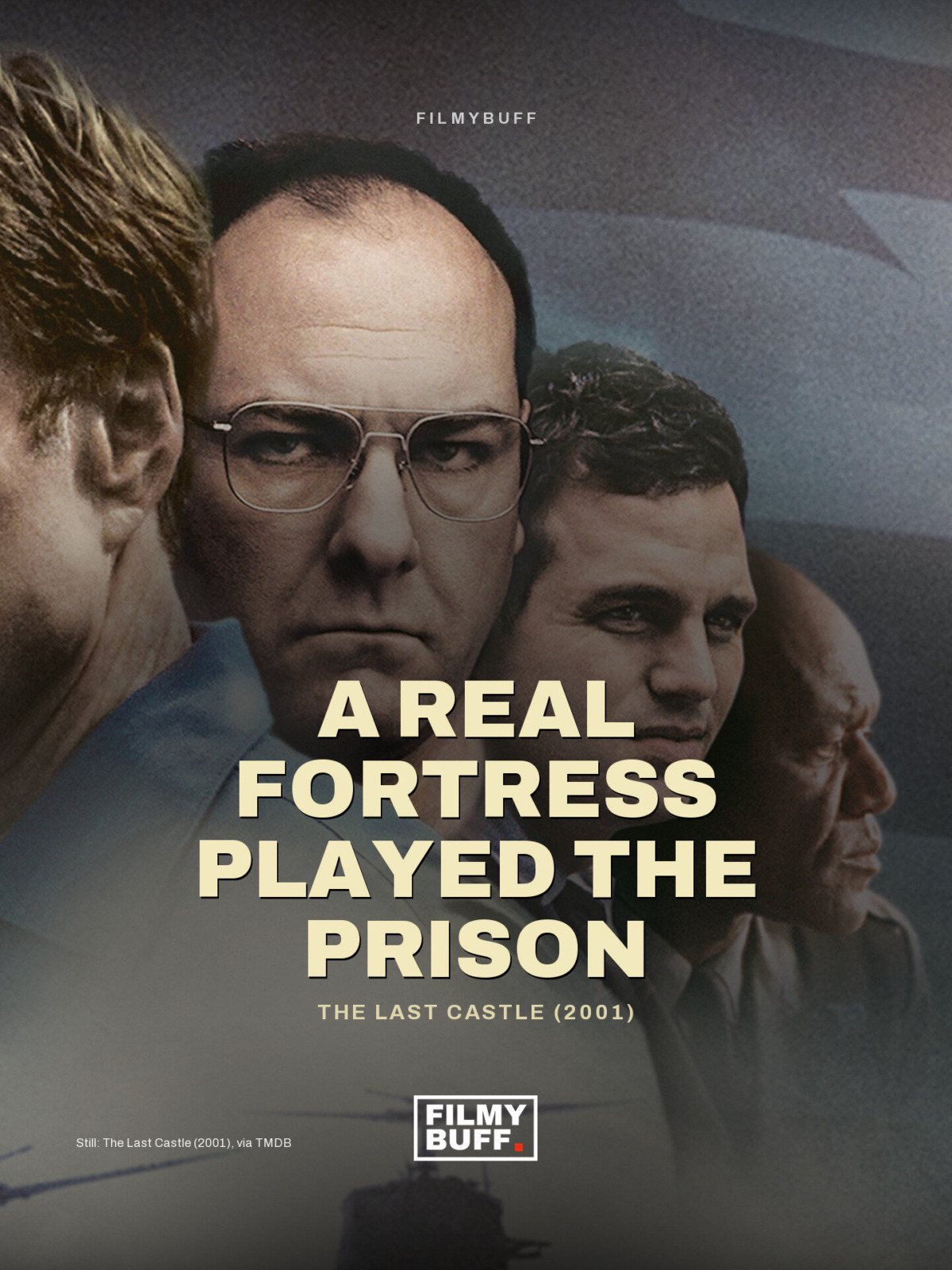
Twenty-five years on, The Last Castle remains an underrated Robert Redford prison drama with a real fortress and a heavyweight cast. It wasn’t a blockbuster, but its production details are full of small obsessions worth revisiting.
A 103-year-old prison played the castle
The film was shot mainly at the former Tennessee State Prison in Nashville, a 103-year-old building chosen because of its Gothic and castle-like appearance. It had previously been used for filming in The Green Mile and Last Dance.
Tennessee sweetened the location deal
The state of Tennessee offered to provide the location rent-free, with exemption from the state’s 6 percent state sales tax. That made the real fortress an even harder production to pass up.
Gandolfini collected $5 million after The Sopranos
James Gandolfini earned $5 million for co-starring in the film after finishing the third season of The Sopranos in March 2001.
A 61-metre wall rose in nine weeks
A crew of 150 worked on refurbishing existing buildings and constructing new buildings in a time limit of nine weeks. They built a wall 61 metres (200 ft) long and six metres (20 ft) high to serve as the prison’s entrance, plus a metal walkway and two guard towers.
The cells were faked in a warehouse
Director Rod Lurie insisted on having the prisoners’ cells face each other, but that is not the case at the Tennessee State Prison. Production designer Kirk Petruccelli solved the problem by creating cells in a warehouse near the prison.
Colour and camera tracked the power shift
To show the balance of power, the film crew used different displays of colour, lighting, camera and costumes. The warden’s office was shot in intense colour to reflect freedom or power, while the yard had washed-out colours, and the contrasts shifted as the story progressed.
The flag was the heart of The Castle
Production designer Kirk Petruccelli described the American flag in the yard as “the heart of The Castle,” and it was the only exemption to the washed-out colour palette. Cinematographer Shelly Johnson, with Lurie and the design team, also used lighting and camerawork to signify the shifting of powers.
Costumes moved from divided to disciplined
Costume designer Ha Nguyen contrasted the prisoners’ clothing before and after General Irwin’s arrival. At first the clothing was divided by ethnicity, with African Americans wearing different headwear, Latinos wearing vests and various arm accessories, and the White Americans in cut-off T-shirts, then the prisoners started wearing more similar clothing in a “sharp military manner.”
The original poster was pulled after September 11
Prior to release, DreamWorks pulled the original poster from circulation, which depicted an American flag flying upside down, a standard distress call. Concerns about public sensitivity related to the September 11 attacks led to the change.
Critics split, audiences gave it an A−
On Rotten Tomatoes, the film has an approval rating of 52% based on 114 reviews, with an average rating of 5.5/10. At Metacritic, it has a score of 43 out of 100 from 32 critics, and audiences polled by CinemaScore gave it an average grade of “A−.”
Which of these production secrets is the one you’d save for the next 25 years?
Facts from Wikipedia: The Last Castle, available under CC BY-SA 4.0.
Film images from TMDB. This product uses the TMDB API but is not endorsed or certified by TMDB.