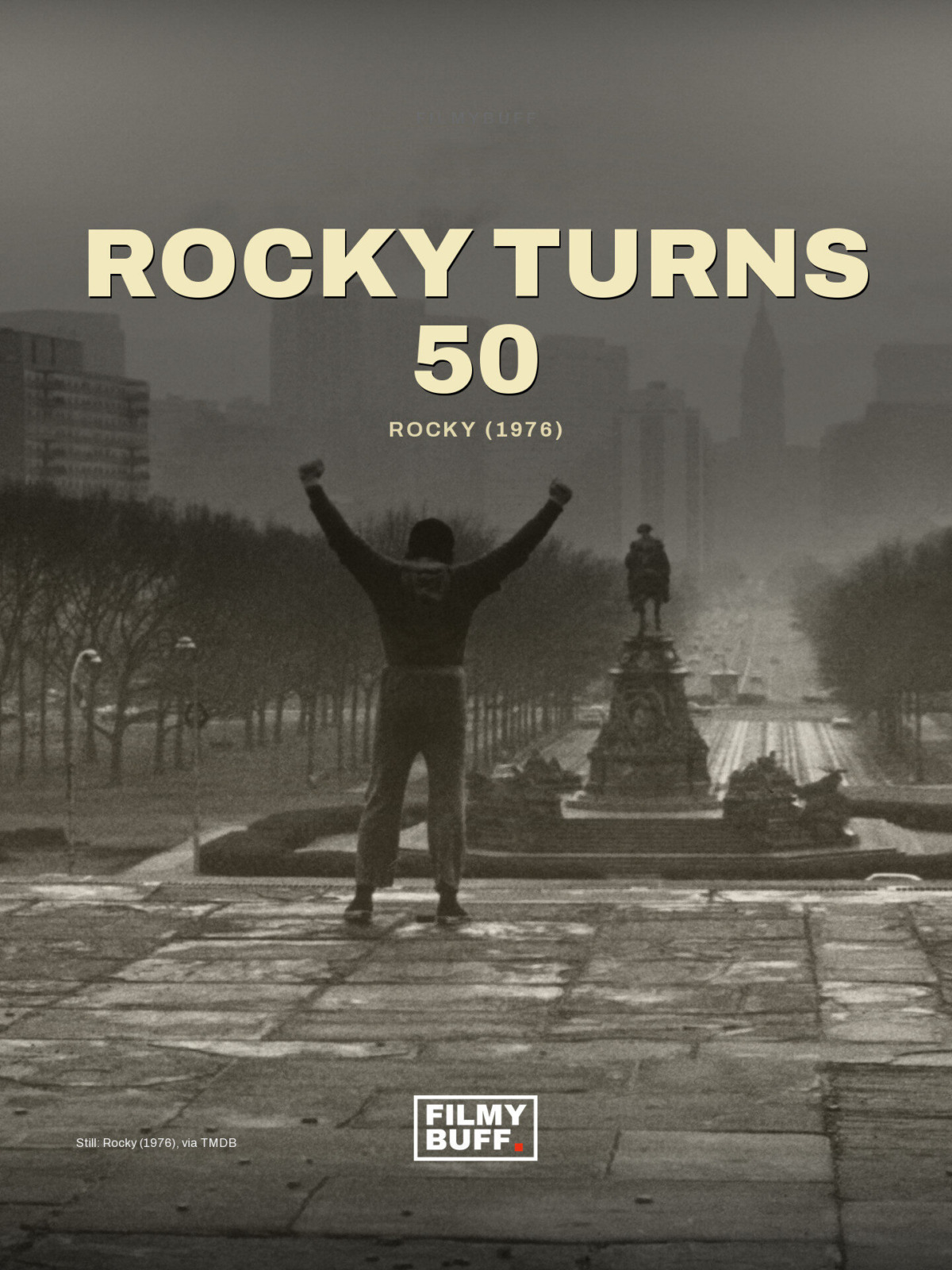
Fifty years ago this week, Rocky arrived as a long-shot film about a long-shot fighter. The story behind it was just as against-the-odds: a fast script, a stubborn unknown, studio doubt and budget workarounds—a deserted skating rink, family members in small roles—that ended up on screen.
The script was written in three and a half days
Sylvester Stallone wrote the screenplay for Rocky in three and a half days, shortly after watching the Muhammad Ali–Chuck Wepner championship match at Richfield Coliseum in Richfield, Ohio, on March 24, 1975. Wepner was TKO’d in the 15th round, with few expecting him to last as long as he did. Wepner later sued Stallone and settled for an undisclosed amount.
ABC wanted the script, but not the writer
Henry Winkler, Stallone’s co-star in The Lords of Flatbush who then broke out as Arthur Fonzarelli on ABC’s Happy Days, took the script to executives at the network. They bought it as a made-for-television movie but insisted that someone else rewrite it. Stallone begged Winkler not to let ABC change writers, so Winkler went back to the executives and offered to return the money; ABC refused at first, but Winkler used his status as one of its biggest stars at the time to convince them to sell the rights back.
United Artists saw a star vehicle, not Stallone
United Artists liked Stallone’s script and viewed it as a vehicle for a well-established star like Robert Redford, Ryan O’Neal, Burt Reynolds, or James Caan. The studio initially thought the project was going to be a disaster.
Apollo Creed and Adrian were almost played by others
Real-life boxer Ken Norton was initially sought for Apollo Creed, but he pulled out and the role was ultimately given to Carl Weathers. According to The Rocky Scrapbook, Carrie Snodgress was originally chosen to play Adrian, but a money dispute forced the producers to look elsewhere. Susan Sarandon and Cher auditioned; Sarandon was deemed too pretty for the character and Cher too expensive. Bette Midler was offered the role but turned it down, and after Talia Shire’s audition the producers and director insisted she play the part.
Ali and Frazier are part of the film’s DNA
Philadelphia-based boxer Joe Frazier has a cameo appearance in the film. He claimed that some of the plot’s most memorable moments—Rocky’s carcass-punching scenes and Rocky running up the steps of the Philadelphia Museum of Art—are taken without credit from his own real-life exploits. Ali influenced the character of Apollo Creed, and at the 49th Academy Awards he told Stallone, “I’m the real Apollo Creed!”
The original script was much darker
The original script had a darker tone: Mickey was portrayed as racist, and the script ended with Rocky throwing the fight after realizing he did not want to be part of the professional boxing world after all. Certain elements of the story were altered during filming.
Rocky was not the first Steadicam film
Inventor Garrett Brown’s new Steadicam was used to achieve smooth photography while running alongside Rocky during the Philadelphia street training sequences and the run up the Art Museum’s flight of stairs, now known as the Rocky Steps. It was also used for some shots in the fight scenes. Rocky is often erroneously cited as the first film to use the Steadicam, but it was actually the third, after Bound for Glory and Marathon Man.
The poster goof was real
The poster seen above the ring before Rocky fights Apollo Creed shows Rocky wearing red shorts with a white stripe when he actually wears white shorts with a red stripe. Avildsen said this was an actual mistake made by the props department that they could not afford to rectify, so the brief scene was written to ensure the audience did not see it as a goof. Stallone has said he was indeed supposed to wear red shorts with a white stripe as Rocky, but changed to the opposite colors at the last moment.
Which of these details changes how you see the film? Tell us your favourite Rocky fact.
Facts from Wikipedia: Rocky, available under CC BY-SA 4.0.
Film images from TMDB. This product uses the TMDB API but is not endorsed or certified by TMDB.