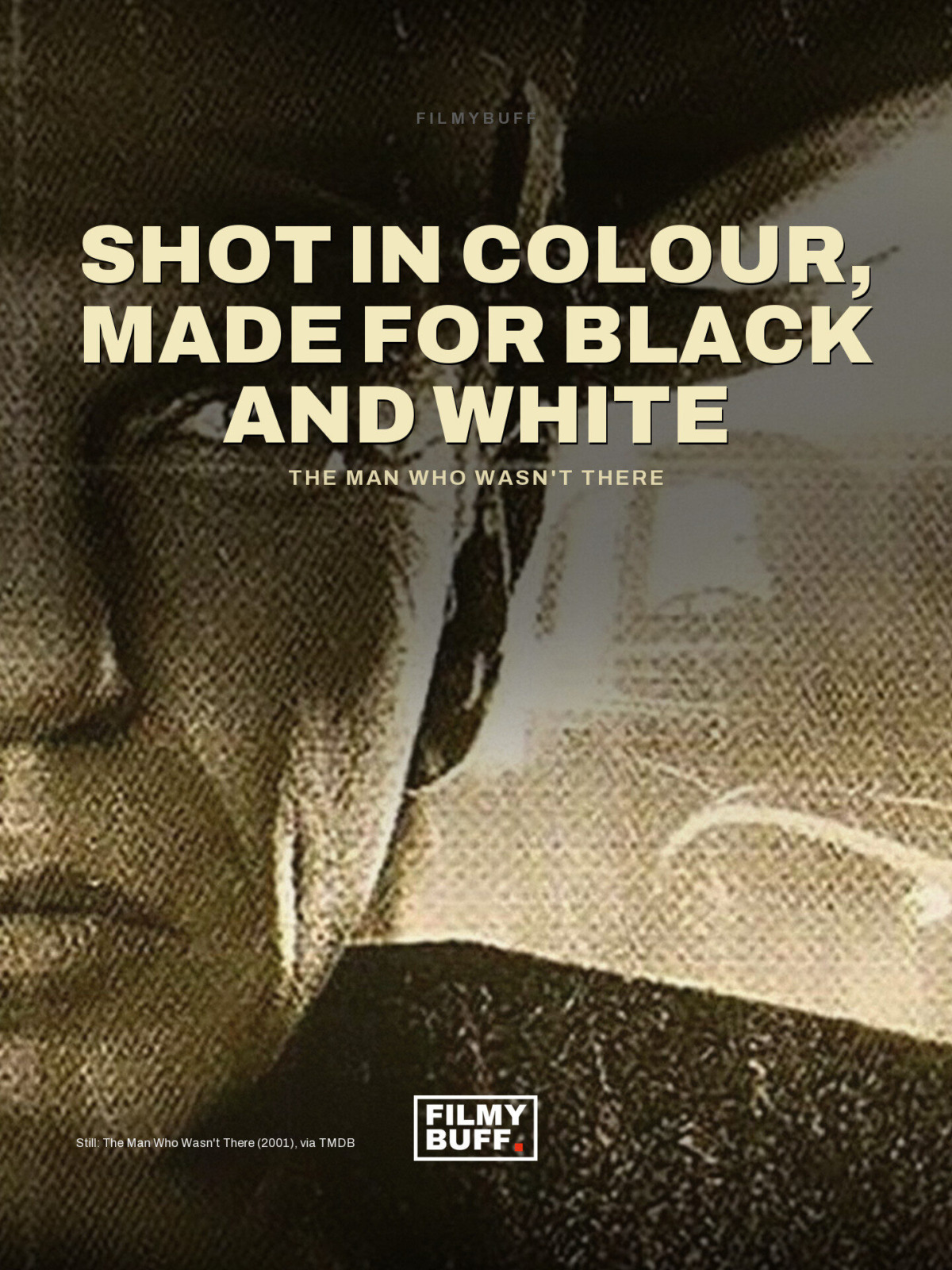
The Man Who Wasn’t There turns 25 this week, and its black-and-white 1949 California is still the first thing people mention. The Coen brothers and cinematographer Roger Deakins didn’t just shoot a noir homage; they shot on colour film and built a monochrome world through lighting, sets and costumes.
It was shot in colour, then turned black and white
The film was captured on colour 35mm stock and converted to black and white during post-production. The decision was partly technical, because black-and-white film rolls had become scarce in recent decades. Yet contractual and marketing requirements meant some countries still received a colour release.
Joel Coen says colour looks “horribly out of place”
Joel Coen was blunt that “the film wasn’t made to be seen in color.” He argued that the colour version would look “horribly out of place” because the grayscale neutralised colours outside the time frame of the plot. For him, black and white felt appropriate to the historical period and evocative for the story in ways colour photography is not.
Deakins shot low contrast, not old-movie shadows
Compared with older American film noir, Deakins used a wide range of grays and attempted to create low contrast without many strong shadows. He used fewer and larger lights, and most shots were taken with the camera at eye level, using normal lenses and a long depth of field. He wanted the film to reflect the era in which it was made, noting “we’re not trying to make an old movie.”
The sets were secretly designed for two versions
Production designer Dennis Gassner and costume designer Mary Zophres had to adapt to the absence of colour and avoid distracting high contrasts. Even so, the team did not lose sight of the colour version: they designed locations avoiding bright colours and preferring browns and grays.
Black and white made close-ups hit harder
The format also changed the way actors looked on screen. Frances McDormand felt the monochrome intensified certain elements: “Just a close-up is very striking because of the shadows and the sense of depth.”
Period underwear had no elastic
Mary Zophres paid attention to the era’s underlayers. McDormand’s stockings had no elastic at the top, and she used garters to hold them up like the extras. Women’s costumes included seamed stockings, girdles and pointy bras; Ed Crane’s wardrobe was built from sports jackets, gabardine and rayon shirts.
Riedenschneider’s suit was inspired by Salvador Dalí
The defense attorney’s peaked-lapel double-breasted suit was unusual for the time. Zophres chose the Dalí-inspired look to suggest opulence.
Thornton copied Sinatra and Burr for Ed’s look
To compose his character’s look, Billy Bob Thornton studied images of figures from that decade and borrowed elements from Raymond Burr and Frank Sinatra. “Once you get the right look, everything in your attitude changes,” Thornton said.
Which of these black-and-white details do you hold onto: the colour-to-monochrome conversion, the low-contrast lighting, or the Dalí suit? Tell us your favourite below.
Facts from Wikipedia: The Man Who Wasn’t There (2001 film), available under CC BY-SA 4.0.
Film images from TMDB. This product uses the TMDB API but is not endorsed or certified by TMDB.