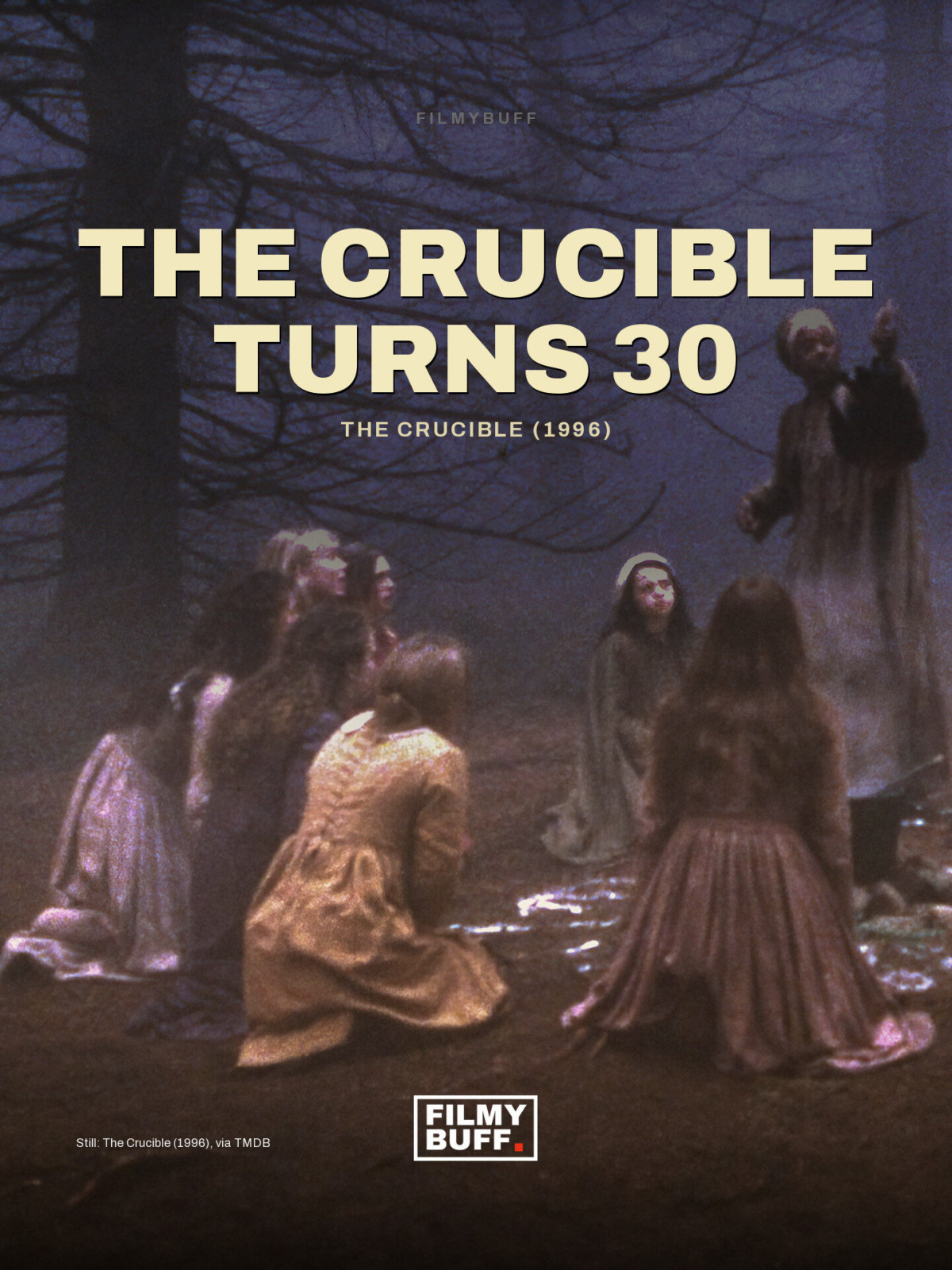
The Crucible turns 30 this week, and Arthur Miller’s screen adaptation of his Salem witch trials play remains a fan-favourite period drama. To mark the milestone, we looked back at the source for the details you may have missed—from a chicken-blood wish to the critics who couldn’t agree.
1. It opens with a chicken-blood wish
In Salem, Massachusetts, in 1692, a group of village girls meet in the woods with slave Tituba, attempting to conjure love spells. Abigail Williams kills a chicken and drinks its blood, wishing for John Proctor’s wife Elizabeth to die. When Abigail’s uncle, Reverend Samuel Parris, discovers them, the girls run away, but his daughter Betty collapses unconscious.
2. Two girls fall into a deep sleep
Betty will not awaken, nor will Thomas and Ann Putnam’s daughter Ruth, who was also conjuring. Giles Corey, who suspects that the children are just acting out, and John Proctor, with whom Abigail had an affair, visit the Parris household. Believing Betty and Ruth to be demonically possessed, Parris and the Putnams call Reverend John Hale from nearby Beverly to examine Betty.
3. Tituba’s confession flips the power
To save herself and the other girls from punishment, Abigail accuses Tituba of witchcraft. After being whipped, Tituba confesses to seeing the Devil and is saved from being hanged. Struck by their new power, the girls begin naming numerous other women, including Elizabeth.
4. A list meant to help backfires
John wants to forget about his affair with Abigail and get back with Elizabeth. He decides to stop Abigail’s accusations, telling his servant, Mary Warren, who is one of the “afflicted” girls, to testify at the trial that the witchcraft was faked. In court, Francis Nurse gives a list of people vouching for the accused; the judges order that all on the list be arrested and brought in for questioning. Giles insists that when Ruth accused Rebecca Nurse, Mr. Putnam was heard to tell Ruth that she had won him a “fine gift of land”.
5. Elizabeth’s lie saves and damns
Elizabeth says she is pregnant and will be spared from death until the baby is born, but John insists that the girls be charged with false witness. To demonstrate Abigail’s complicity, John confesses to his affair with her, claiming that she accused Elizabeth in order to get rid of her so that she could marry him. Abigail denies this, so Elizabeth is called in to verify it; unaware that John confessed and wanting to save his reputation, she lies.
6. A yellow bird turns the court
As Reverend Hale tries to persuade the court of John’s honesty, the girls turn the court further against the Proctors by screaming that Mary Warren is attacking them as a “yellow bird”. John repeats his accusation.
7. Rotten Tomatoes gives it 71%
The film has an overall score of 71% on the review aggregation website Rotten Tomatoes, based on 65 critic reviews, with an average rating of 7.3/10. The critics consensus states: “This staid adaptation of The Crucible dutifully renders Arthur Miller’s landmark play on the screen with handsome production design and sturdy performances, if not with the political anger and thematic depth that earned the drama its reputation.”
8. Navasky read it as a McCarthy echo
Victor Navasky of The New York Times wrote that the film was “thought impossible to make during the McCarthy years” due to its allegorical connections to McCarthyism, yet was “probably destined for Hollywood all along”.
9. Critics split from an A to 2 stars
Owen Gleiberman of Entertainment Weekly gave the film a grade of “A”, calling the adaptation “joltingly powerful” and noting the “spectacularly”-acted performances of Day-Lewis, Scofield, and Allen. Roger Ebert gave the film 2 out of 4 stars, writing that the “story has all the right moves and all the correct attitudes, but there is something lacking at its core; I think it needs less frenzy and more human nature”. Philip Thomas of Empire gave the film 5 out of 5 stars, calling it an “almost perfect screen adaptation”.
10. AFI gave it a courtroom nod
The film is recognized by American Film Institute in these lists: 2008: AFI’s 10 Top 10: Nominated: Courtroom Drama Film.
Which of these Crucible details surprised you most? Tell us your favourite fact in the comments.
Facts from Wikipedia: The Crucible (1996 film), available under CC BY-SA 4.0.
Film images from TMDB. This product uses the TMDB API but is not endorsed or certified by TMDB.