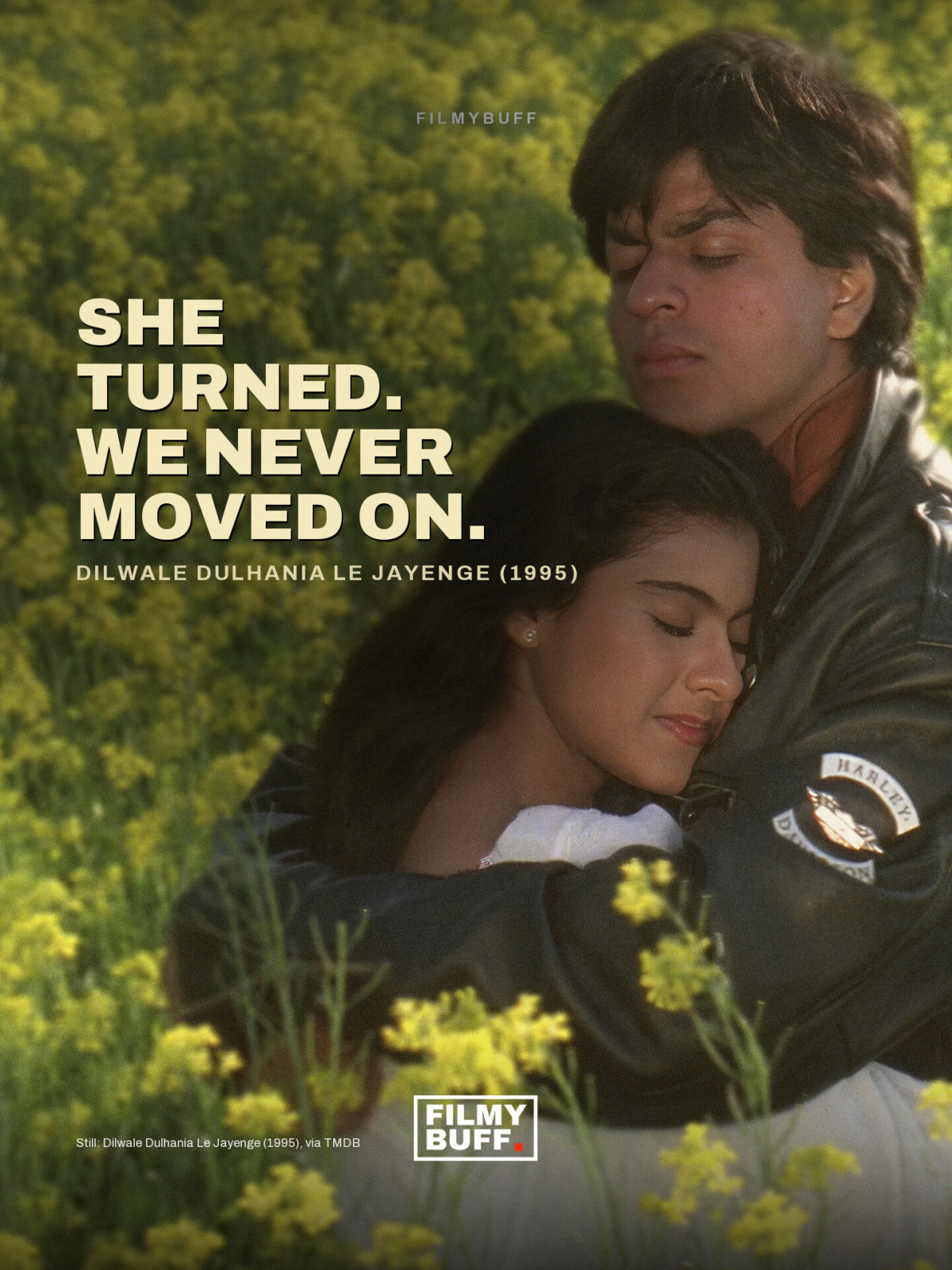
Even now, when someone says “Palat,” I feel the mustard field. The scene sits late in the first half, before the story resolves, when Raj and Simran are in Punjab and he offers no speech—just a two-syllable dare: if she turns, she loves him; she turns, and everything pivots.
Why the turn works
It’s a dare, not a declaration. Raj puts the burden on her, so the moment becomes a test of agency. The writing gives the audience a condition, the staging keeps the distance, and the camera lets the turn breathe. Shah Rukh underplays the command with a half-smile that could go either way. Kajol does the impossible with her shoulders: she doesn’t just turn, she surrenders to the inevitability of it. The music swells just enough to feel earned, never enough to feel forced. It isn’t a spectacle; it’s a heartbeat.
“Agar woh mujhse pyaar karti hai, toh woh palat ke dekhegi.”
The line people quote is almost never the whole sentence. It’s the two syllables—“Palat”—that survive. That’s the scene’s real magic: it reduces love to one word and asks the other person to complete it.
What it did for the film and its stars
For DDLJ, this was the turn that made the whole film feel predestined. It helped fix Shah Rukh Khan as the romantic hero who could be cocky and aching at once, and it confirmed Kajol as the actor whose face could carry an entire answer. For two stars who would define the decade and beyond, this was the scene where the template locked: the boy who asks, the girl who chooses, the audience that believes. It didn’t create their stardom; it distilled it.
If you’re watching for the first time, don’t let the romance blind you to the craft. Watch Simran’s eyes just before the turn, and notice how the film trusts an audience to understand everything from one small movement. That trust is why the scene still holds.
Watch the original: YRF on YouTube. Shown for review and comment; the rights stay with the makers.