Fifteen years after its release, Hugo still feels like a love letter folded into a children’s mystery. It is a 3D adventure about a boy, an automaton and the forgotten pioneer Georges Méliès, but the making of the film is full of sharp turns. This week’s anniversary is a good moment to look at the details behind Scorsese’s big swing.
A 93% Rotten Tomatoes score couldn’t save it
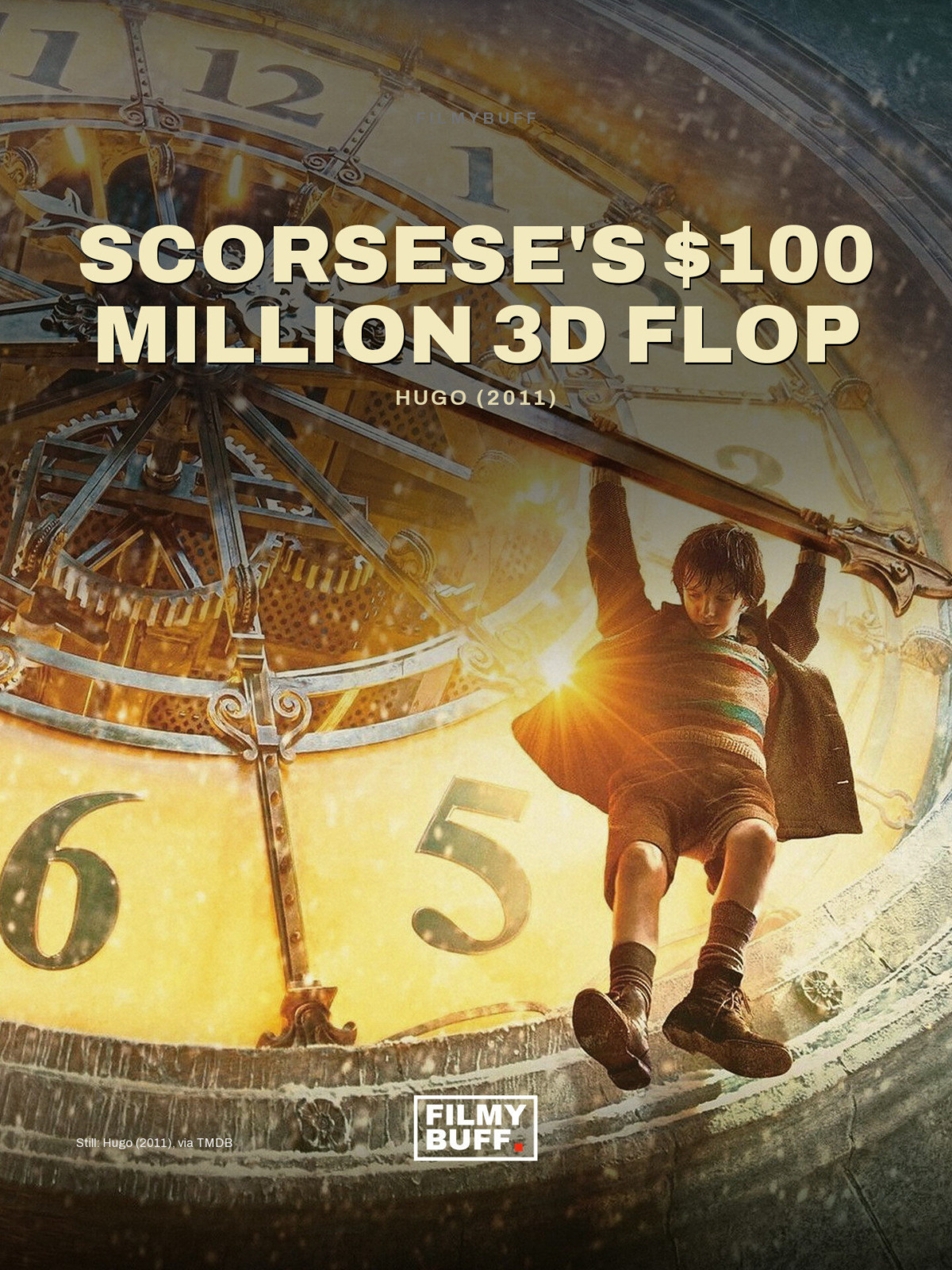
Hugo holds an approval rating of 93% with a mean of 8.3 out of 10 based on 232 reviews on Rotten Tomatoes. Metacritic assigned a weighted average score of 83 out of 100, indicating “universal acclaim,” while CinemaScore audiences gave an average grade of “B+.” Despite that praise, Hugo was cited as one of the year’s notable box-office flops, with an estimated net loss of $100 million.
Scorsese thought Chloë Grace Moretz was British
Moretz adopted a British accent for Isabelle, reflecting the longstanding convention of using British accents in European historical settings, even when the setting is not Britain. The actor later said Scorsese initially believed she was British during her audition.
It began with a different director and title
GK Films acquired the screen rights to The Invention of Hugo Cabret shortly after the book was published in 2007. Chris Wedge was initially signed to direct the adaptation, while John Logan was contracted to write the screenplay. The film was initially titled Hugo Cabret.
The budget spiraled from $100 million to $170 million
Hugo was originally budgeted at $100 million, but ran over with a final budget between $156 million and $170 million. In February 2012, producer Graham King summed up the experience: “Let’s just say that it hasn’t been an easy few months for me—there’s been a lot of Ambien involved.”
Paris locations fed 700 meals a day
Principal photography began in London on June 29, 2010, with Shepperton Studios as the first shooting location. The Nene Valley Railway near Peterborough lent original Compagnie Internationale des Wagons-Lits rolling stock to the studio. In August 2010, production moved to Paris for two weeks, using the Sainte-Geneviève Library, the Sorbonne and the Théâtre de l’Athénée; Lycée Louis-le-Grand served as the base, and its cafeteria served 700 meals a day for cast and crew.
The 3D complexity cost Scorsese three line-producers
Producer Graham King said the film’s box-office results were painful and did not blame the director. “Budget-wise, there just wasn’t enough prep time and no one really realized how complicated doing a 3D film was going to be,” he said. “I went through three line-producers because no one knew exactly what was going on.” Once the schedule started getting out of whack, he added, “things just spiraled and spiraled and that’s when the avalanche began.”
The score mixed Saint-Saëns, Satie, and an uncredited pianist
The soundtrack includes an Oscar-nominated original score by Howard Shore. It also makes prominent use of Danse macabre by Camille Saint-Saëns and Gnossienne No. 1 by Erik Satie. French pianist and composer Jean-Michel Bernard provided additional music uncredited, and Zaz performs on track 20, “Cœur volant.”
James Cameron called it a masterpiece
Roger Ebert gave Hugo four out of four stars, writing that it is “unlike any other film Martin Scorsese has ever made, and yet possibly the closest to his heart: a big-budget, family epic in 3-D, and in some ways, a mirror of his own life.” James Cameron kept it simpler: he called Hugo “a masterpiece.”
Which of these Hugo details surprised you most? Tell us the moment from the film you still think about.
Facts from Wikipedia: Hugo (film), available under CC BY-SA 4.0.
Film images from TMDB. This product uses the TMDB API but is not endorsed or certified by TMDB.