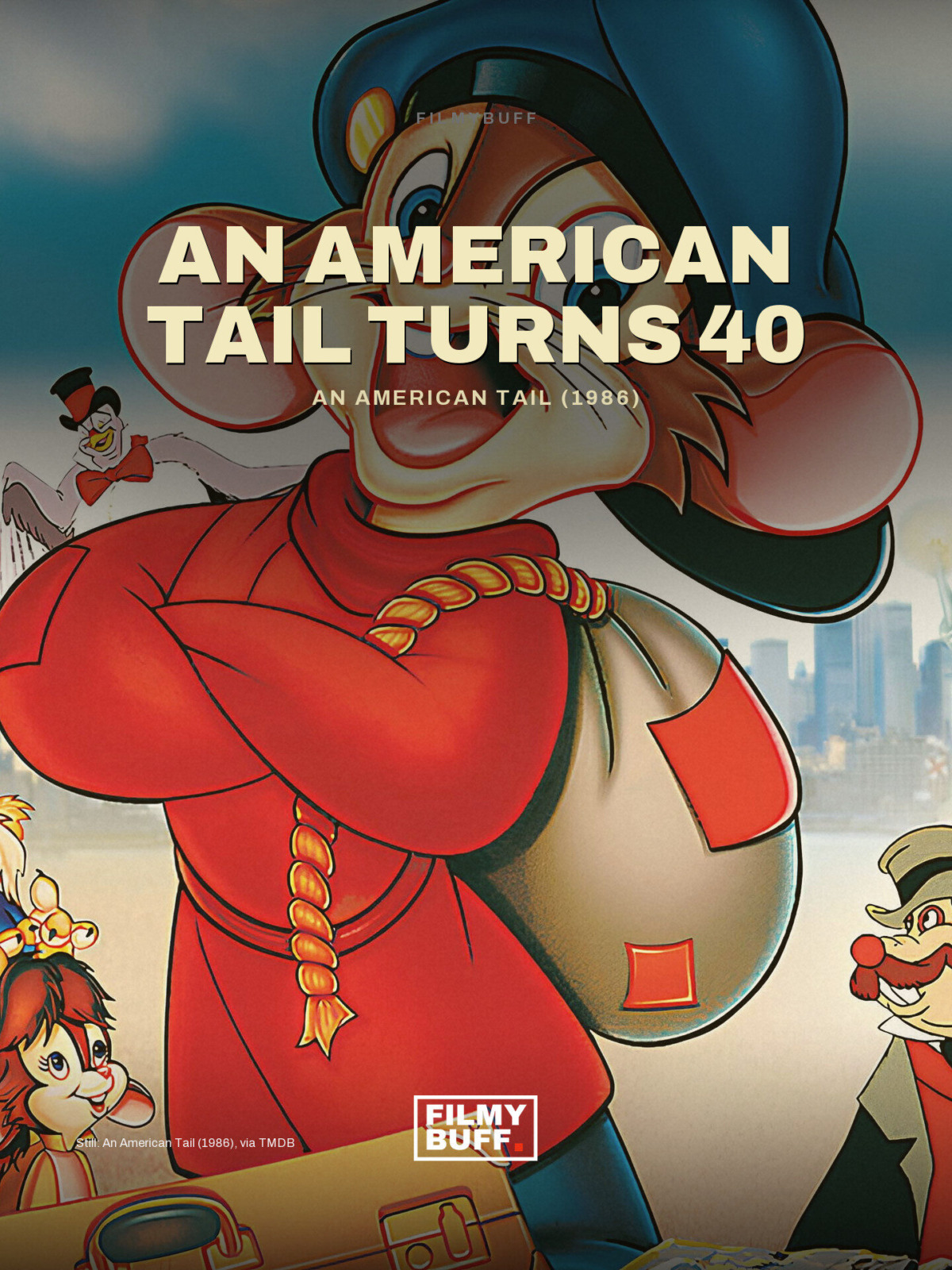
An American Tail was released on 21 November 1986 and turns 40 today. Don Bluth’s story of Fievel Mousekewitz, a Russian-Jewish mouse separated from his family on the way to America, arrived as a risk: a tight budget, an animation team without a union, and the first animated feature to carry Steven Spielberg’s name. The making of the film is full of accidents and compromises that shaped what audiences saw.
Fievel’s voice was found at an Oscar Mayer audition
Don Bluth described voice casting as sometimes choosing a name voice because it fits the essence of the character, and other times seeking an obscure voice and just listening to it. Phillip Glasser was discovered by accident when Bluth and his crew overheard him auditioning for an Oscar Mayer commercial.
Spielberg’s first animated feature began as a TV special
Production began in December 1984 as a collaboration between Spielberg, Bluth and Universal, based on a concept by David Kirschner. Originally conceived as a television special, it became a feature film because Spielberg felt it had more potential.
“Make me something pretty like NIMH”
Spielberg asked Bluth to “make me something pretty like you did in NIMH…make it beautiful.” Bluth later said: “Steven has not dominated the creative growth of Tail at all. There is an equal share of both of us in the picture.”
A Hamlet audition landed Warren T. Rat
John Finnegan won the role of Warren T. Rat by reciting excerpts of Shakespeare’s Hamlet in the voice of a Brooklyn taxi driver. The idea inspired the writers to make Warren a pretentious illiterate who continually misquoted Shakespeare.
Dom DeLuise added Tiger’s back scratch
Dom DeLuise had worked previously with Bluth in The Secret of NIMH and added material to the script at various points. During the song “A Duo,” he suggested they stop the music where the lyrics mention “back scratch” and have Fievel actually scratch Tiger’s back.
Henri was originally Sid Caesar
Henri was originally to be voiced by comedian Sid Caesar and was conceived as scraggly and worn. Later, Plummer was cast for the part, and Henri was drawn with a more dignified look. Bluth felt Henri was an essential character to act as a voice for the statue welcoming Fievel to the new world.
A $6.5 million budget stretched to $9 million
Bluth agreed to accept $6.5 million to get the film produced, and that figure later grew to $9 million. At the time, Disney was spending around $12 million per film. With the agreement of his employees, salaries were frozen for a year and half.
“Somewhere Out There” became an animated standard
The James Horner score was performed by the London Symphony Orchestra and the Choir of King’s College. “Somewhere Out There,” performed by Linda Ronstadt and James Ingram, won two Grammy Awards and became one of the most popular songs from an animated feature since the 1950s.
Which of these eight An American Tail details surprised you most? Tell us your favourite fact.
Facts from Wikipedia: An American Tail, available under CC BY-SA 4.0.
Film images from TMDB. This product uses the TMDB API but is not endorsed or certified by TMDB.