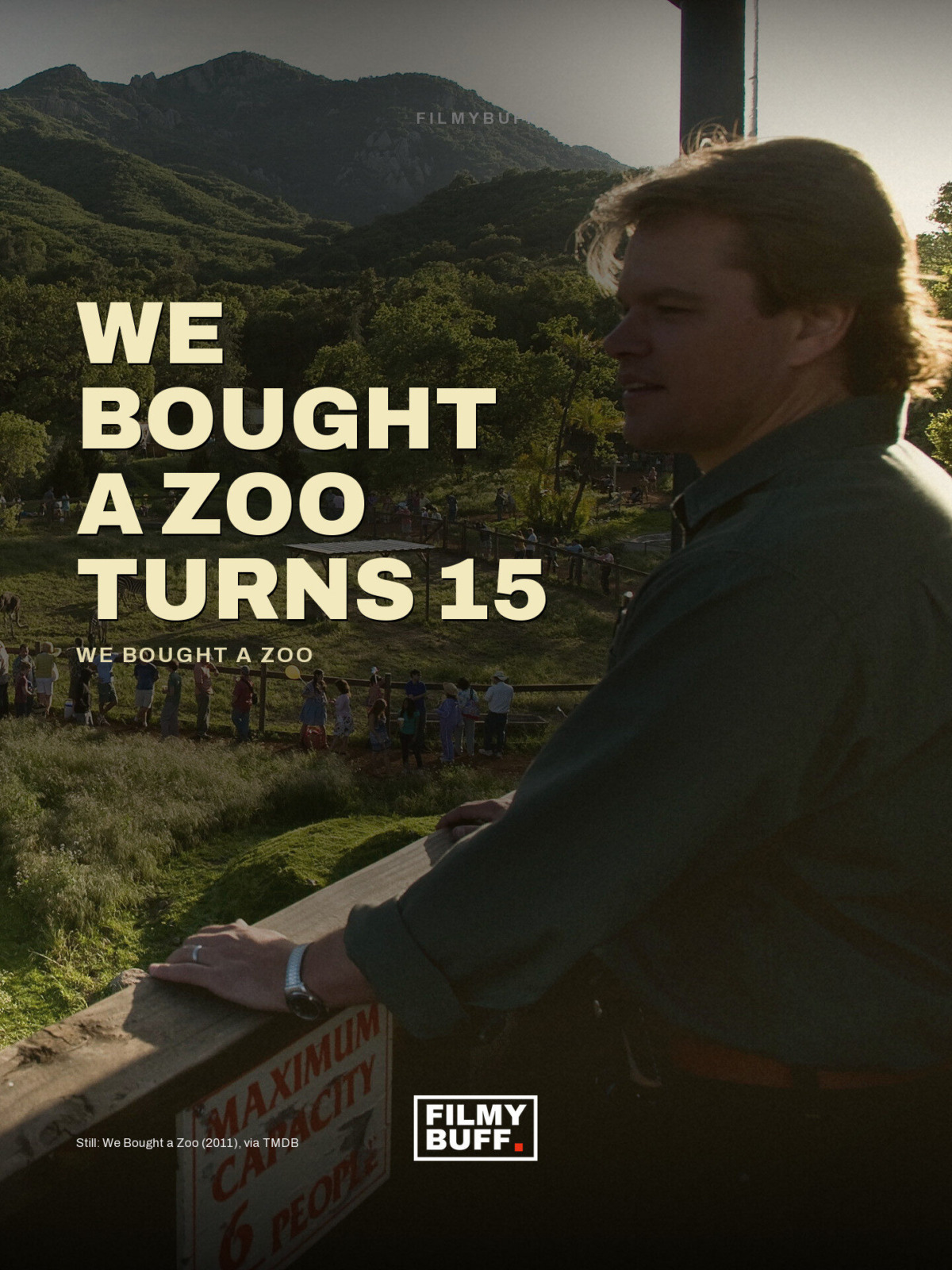
Fifteen years on, We Bought a Zoo remains one of Cameron Crowe’s warmest family films—a story about second chances that arrived in cinemas on December 21, 2011. This week it turns 15, so it feels like the right moment to revisit the details behind the movie, from the pitch that won Matt Damon to the rare box-office bounce that kept it in theatres.
Cameron Crowe returned to directing after Elizabethtown
In May 2010, Cameron Crowe agreed to direct the 20th Century Fox adaptation of Benjamin Mee’s memoir We Bought a Zoo. He began rewriting the film’s script, which was originally written by Aline Brosh McKenna. It was the first narrative film Crowe had directed since 2005’s Elizabethtown.
A zoo was built for the shoot
The animal world of the film was created at Greenfield Ranch in Hidden Valley, Thousand Oaks, California. The zoo scenes were filmed there, where a zoo was erected specifically for the production.
Matt Damon was recruited on the True Grit set
Crowe traveled to the set of True Grit to persuade Matt Damon to take the lead. He arrived with a script, a CD of live versions of classic songs that Crowe burned himself, and a copy of the 1983 film Local Hero. His instruction was “to not just read the script and make a decision.” Damon was moved by the music and found Local Hero a “masterpiece.” Crowe had decided on Damon halfway through their meeting, though Fox still had a shortlist of candidates.
Jónsi was part of the film from the very beginning
In August 2011, it was announced that Jónsi Birgisson of Sigur Rós would compose the score. Crowe described the choice as “only natural,” saying Jónsi “has been a part of the making of We Bought A Zoo from the very beginning.”
Gathering Stories nearly cracked the Oscar shortlist
The song Gathering Stories was on the shortlist of 39 songs that had a chance at a Best Original Song nomination at the 84th Academy Awards. Jónsi co-wrote it with Crowe. While the official CD release of the soundtrack includes only music by Jónsi and Sigur Rós, the complete film soundtrack included a variety of artists.
It pulled off a rare second-weekend bounce
We Bought a Zoo grossed $2,984,875 on its opening day in the U.S. box office, making it the sixth highest-grossing film that weekend. It earned $14,604,645 in its first four days of screening, and eventually took $75,624,550 in North America and $37,764,426 internationally for a worldwide total of $113,388,976. Even rarer, it is one of only twelve feature films to be released in over 3,000 theaters and still improve in its second weekend, increasing 41.4% from $9,360,434 to $13,238,241.
Critics were split, audiences were warmer
Rotten Tomatoes gives the film 64% from 171 reviews, while Metacritic scores it 58 out of 100 from 41 critics. CinemaScore audiences gave it an A. Roger Ebert called it “too much formula and not enough human interest,” though he said Damon “makes a sturdy and likable Benjamin Mee.” The Hollywood Reporter praised its “heart, humanity and a warmly empathetic central performance from Matt Damon,” even while noting the film “at times overplays the whimsy.”
Jimmy Kimmel kept the joke alive
The long-running gag-feud between Matt Damon and Jimmy Kimmel continued at the 89th Academy Awards, where Kimmel jokingly mocked Damon’s performance in We Bought a Zoo. It is a small piece of the film’s afterlife that still gets a laugh.
From a custom burned CD to a 41.4% second-weekend jump, the film is full of details that are easy to miss on a first watch. What is your favourite We Bought a Zoo fact? Tell us the one you would save.
Facts from Wikipedia: We Bought a Zoo, available under CC BY-SA 4.0.
Film images from TMDB. This product uses the TMDB API but is not endorsed or certified by TMDB.