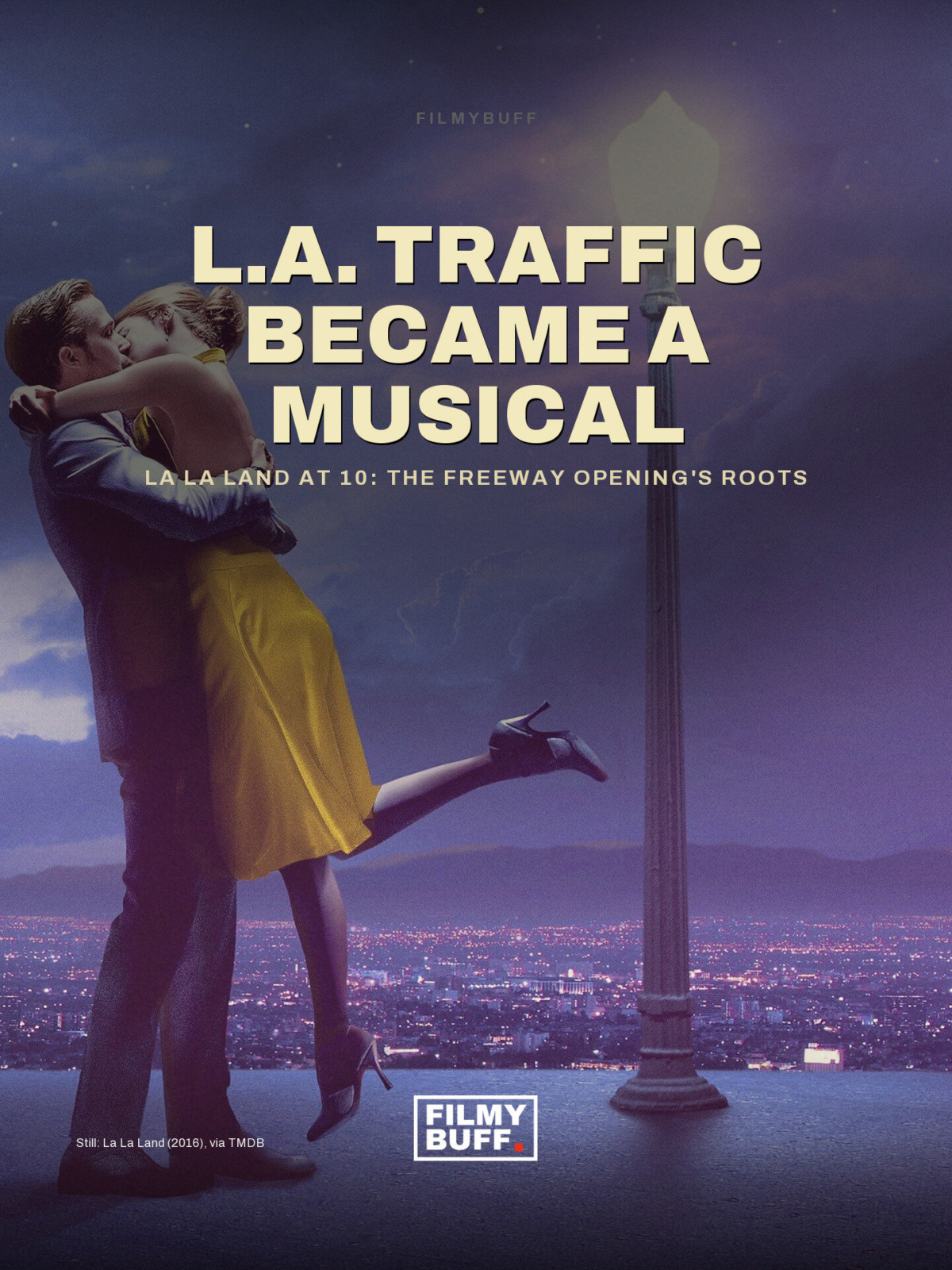
La La Land turns 10 this week, and the film still opens with a small miracle: a traffic-jam musical number, “Another Day of Sun,” in which Sebastian and Mia first cross paths. That opener is pure Los Angeles, and the making of the film around it was just as deliberate.
A traffic jam became the opening number
The film opens with Mia and Sebastian stuck in Los Angeles traffic during “Another Day of Sun.” When Chazelle and Hurwitz moved to Los Angeles in 2010, he did not try to match the city to the charms of Paris or San Francisco; he focused on the qualities that make the city distinctive: the traffic, the sprawl, and the skylines. That focus gives the freeway opening its texture.
It began as a Harvard idea
Chazelle first conceived the film while attending Harvard University with Justin Hurwitz. The two explored the concept in their senior thesis through a low-budget musical about a Boston jazz musician, Guy and Madeline on a Park Bench. After graduating, both moved to Los Angeles in 2010 and continued writing, changing the location from Boston to Los Angeles.
The script had a city-symphony heart
Chazelle was moved by the tradition of 1920s “city symphony” films, such as Manhatta and Man with a Movie Camera, that paid tribute to cities. His idea was “to take the old musical but ground it in real life where things don’t always exactly work out.” He also wanted to salute creative people who move to Los Angeles to chase their dreams.
Old Hollywood was the template
The style and tone were inspired by Jacques Demy’s The Umbrellas of Cherbourg and The Young Girls of Rochefort, especially the latter, which was more dance and jazz-oriented. The film makes visual allusions to Hollywood classics such as Broadway Melody of 1940, Singin’ in the Rain, The Band Wagon, and An American in Paris. About An American in Paris, Chazelle commented:
“That’s a movie that we just pillaged. It’s an awesome example of how daring some of those old musicals really were.”
The struggle is the point
The film shares character development and themes with Chazelle’s Whiplash. Chazelle said: “They’re both about the struggle of being an artist and reconciling your dreams with the need to be human. La La Land is just much less angry about it.” He wrote the screenplay for La La Land in 2010, when the film industry seemed out of reach for him.
No studio wanted an original jazz musical
Chazelle was unable to produce the film for years because no studio was willing to finance an original contemporary musical with no familiar songs. The Hollywood Reporter called a jazz musical an “extinct genre.”
The leads almost weren’t Stone and Gosling
Miles Teller and Emma Watson were originally slated to star. Watson dropped out to honor her commitments to Disney’s live-action Beauty and the Beast remake, while Teller exited via long contract negotiations. Coincidentally, Gosling turned down the Beast role in Beauty and the Beast in favor of La La Land. Michael B. Jordan was also considered for the role of Sebastian, but Chazelle cast Gosling and Stone immediately after Summit bought the film.
Stone and Gosling brought their own bruises
Emma Stone loved musicals since seeing Les Misérables when she was eight. Her favorite film is the 1931 Charlie Chaplin romantic comedy City Lights. She moved to Hollywood at fifteen and struggled constantly to get auditions during her first year. Ryan Gosling learned tap dancing and piano for his role. A casting director’s phone call during one of Gosling’s emotional audition scenes was used for Mia.
The numbers were built for single takes
Chazelle wanted the film’s musical numbers to be filmed “head to toe” and performed in a single take, like the 1930s works of Fred Astaire and Ginger Rogers. The film emulated the widescreen CinemaScope look of 1950s musicals such as It’s Always Fair Weather, shot on celluloid 4-perf Super 35mm film with Panavision anamorphic lenses in CinemaScope’s 2.55:1 aspect ratio.
Which making-of detail from La La Land do you still think about? The freeway opening still has ours.
Facts from Wikipedia: La La Land, available under CC BY-SA 4.0.
Film images from TMDB. This product uses the TMDB API but is not endorsed or certified by TMDB.