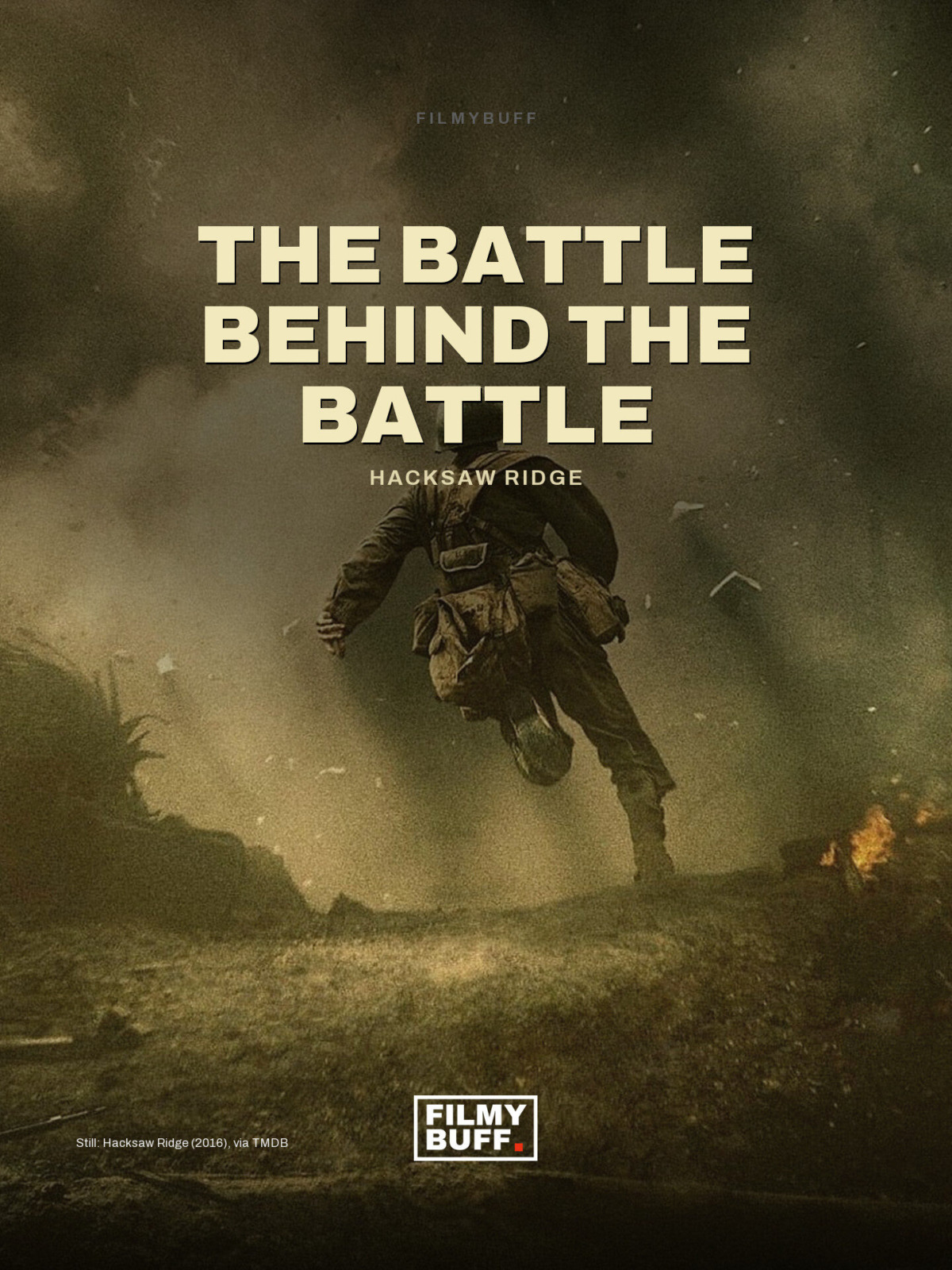
Ten years after its release, Hacksaw Ridge still earns its place in the war-film conversation. The story of Desmond Doss, an American combat medic who refused to use a weapon, became a $40 million international production only after a long fight. This week, we break down the facts behind the battle to bring Doss to the screen.
It spent 14 years in development limbo
Hacksaw Ridge was in development limbo for 14 years. Producers had tried for decades to film Desmond Doss’s story, including decorated war hero Audie Murphy and Hal B. Wallis. In 2001 screenwriter/producer Gregory Crosby wrote the treatment and brought the project to producer David Permut.
Mel Gibson said no twice
After acquiring the rights, producer Bill Mechanic approached Mel Gibson, wanting a concoction of violence and faith, as Gibson had done with The Passion of the Christ. Gibson turned the offer down twice, as he had previously with Braveheart. Nearly a decade later he agreed to direct, with the decision announced in November 2014.
Australian identity made the budget work
The production had a $40 million budget and still faced big challenges. When Australian tax incentives were taken off the table, the film had to qualify as Australian to receive government subsidies. Gibson’s early years in Australia helped the film qualify, along with most of the cast being Australian. According to producer Bill Mechanic, Australian state and federal subsidies made financing the film possible.
Garfield cried at the first read
Andrew Garfield was confirmed to play Desmond Doss in November 2014. He admitted that he cried the first time he read the screenplay, and he visited Doss’ hometown and touched his various tools. Gibson was drawn to Garfield the first time he saw his performance in The Social Network.
Two composers exited before the score
James Horner was originally approached to compose the score, but after Horner’s death in 2015 John Debney replaced him. Debney was then replaced by Rupert Gregson-Williams after his score was rejected before the Venice Film Festival premiere. Gregson-Williams said the soundtrack reflected “his spirituality without being pious, and his bravery without celebrating violence.” The score was recorded at Abbey Road Studios in London with an orchestra of 70 musicians and a 36-voice choir conducted by Cliff Masterson.
The battle sounds came from archives
Kevin O’Connell won his first Academy Award for sound mixing in this film after 21 nominations. He stated that budget constraints forced him to use archival sounds of WWII-era weapons, keeping the production within its financial limits.
Venice gave it a 10-minute ovation
The world premiere occurred on September 4, 2016, at the 73rd Venice Film Festival, where it received a 10-minute standing ovation. The film was released in Australia on November 3, 2016, by Icon Film Distribution, and in the United States on November 4, 2016, by Lionsgate/Summit Entertainment.
Which detail from the long road to Hacksaw Ridge surprised you most?
Facts from Wikipedia: Hacksaw Ridge, available under CC BY-SA 4.0.
Film images from TMDB. This product uses the TMDB API but is not endorsed or certified by TMDB.