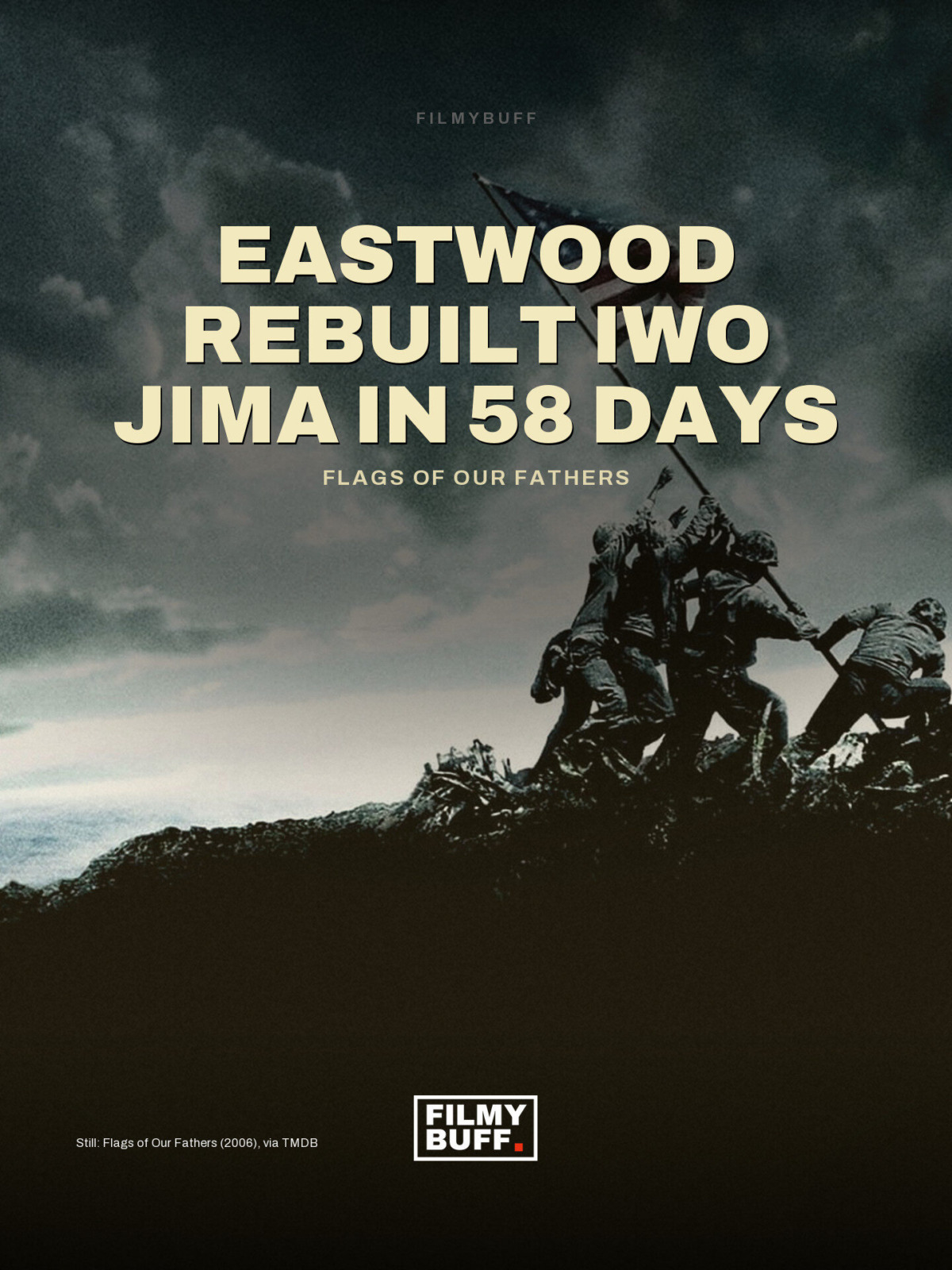
This week, Flags of Our Fathers turns 20, and the unflinching, technically ambitious Iwo Jima landing that opens its story remains the reason to revisit it. Based on the 2000 book by James Bradley and Ron Powers, Clint Eastwood’s American viewpoint of the 1945 Battle of Iwo Jima was not a simple location pickup: it took a purchased book, two screenwriters, 58 days, and stand-ins an ocean away from the real island.
DreamWorks grabbed the book in June 2000
The film rights to the book were purchased by DreamWorks Pictures in June 2000. Producer Steven Spielberg brought William Broyles to write the first drafts of the script.
Eastwood brought Paul Haggis to rewrite
Director Clint Eastwood later brought Paul Haggis to rewrite. In the process of reading about the Japanese perspective of the war, in particular General Tadamichi Kuribayashi, Eastwood decided to film a companion piece with Letters from Iwo Jima, which was shot entirely in Japanese.
Scott Eastwood and Bradley Cooper auditioned
Clint’s son Scott and Bradley Cooper auditioned for one of the leading roles. Jared Leto was originally cast as Rene Gagnon but had to back out due to a tour commitment with his band, Thirty Seconds to Mars.
The Iwo Jima landings were shot in 58 days
Flags of Our Fathers was shot in the course of 58 days. The film’s version of the invasion follows the Navy bombarding suspected Japanese positions for three days, then the Marines’ amphibious landings securing a beachhead on Iwo Jima on February 19, 1945.
Iceland and Southern California stood in for Iwo Jima
Although the film is taken from the American viewpoint of the battle, it was filmed almost entirely in Iceland and Southern California, with a few scenes shot in Chicago. The locations recreated the Pacific island where the flag was raised on Mount Suribachi.
The budget tightened from $80m to $55m
The film cost $55 million, although it was originally budgeted at $80 million. Variety subsequently downgraded the price tag to $55 million.
Shooting wrapped before Letters began
Shooting ended early 2006, before production for Letters from Iwo Jima began in March 2006. Eastwood directed, co-produced and scored Flags of Our Fathers; the screenplay is credited to William Broyles Jr. and Paul Haggis.
Critical acclaim met a soft box office
Flags of Our Fathers earned just $65,900,249 worldwide against an estimated $90 million production budget, despite critical acclaim. On review aggregator Rotten Tomatoes, it has an approval rating of 76% based on 239 reviews; Metacritic scored it 79 out of 100 based on 39 reviews. Roger Ebert gave the film four stars out of four. It made the top-10 list of the National Board of Review, Eastwood earned a Golden Globe nomination for directing, and it was nominated for two Academy Awards — for Best Sound Mixing and Sound Editing. Film critic Richard Roeper said, “Flags of Our Fathers stands with the Oscar-winning Unforgiven and Million Dollar Baby as an American masterpiece.” Its companion film Letters From Iwo Jima was more profitable with a box office run of $71 million on a budget of $19 million.
Which piece of the production surprises you most — the 58-day shoot, the Iceland and Southern California sleight of hand, or the budget squeeze from $80 million to $55 million? Tell us your favourite fact.
Facts from Wikipedia: Flags of Our Fathers (film), available under CC BY-SA 4.0.
Film images from TMDB. This product uses the TMDB API but is not endorsed or certified by TMDB.