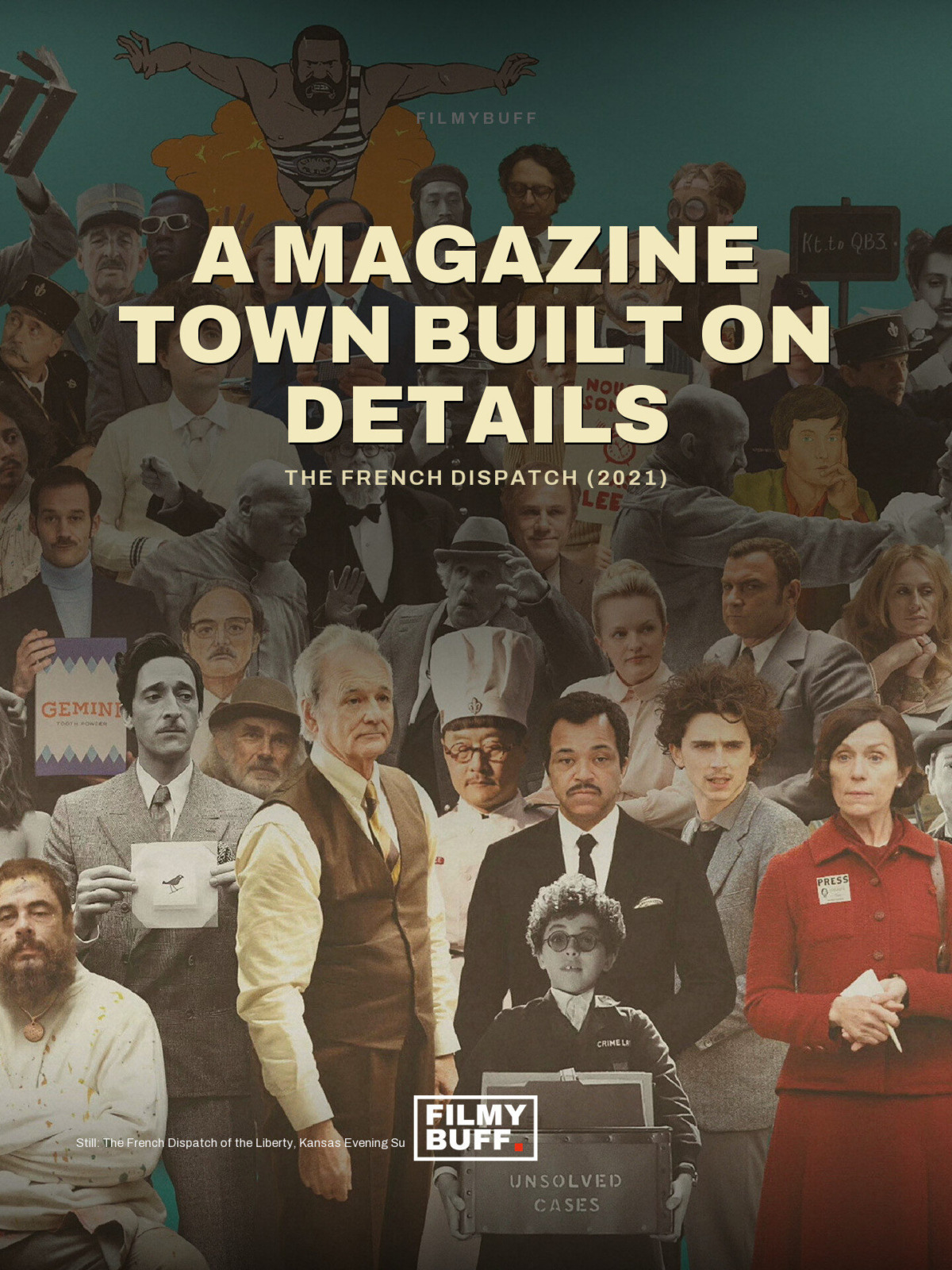
The French Dispatch turns five this week, and its clockwork design still rewards a closer look. Wes Anderson wrote, directed and co-produced the 2021 American anthology comedy drama, working from a story he conceived with Roman Coppola, Hugo Guinness and Jason Schwartzman. Across three storylines, the French news bureau of the fictional Liberty, Kansas Evening Sun publishes its final issue.
Chalamet’s part was written with him in mind
Timothée Chalamet’s role was written with him in mind. In December 2018, Anderson was announced to write and direct, with Frances McDormand, Bill Murray, Benicio del Toro and Jeffrey Wright among the cast, and Léa Seydoux confirmed alongside Tilda Swinton and Mathieu Amalric. Steven Rales produced under his Indian Paintbrush banner and Fox Searchlight Pictures distributed.
It started as a French musical, then wasn’t
In August 2018, reports said Anderson would write and direct an untitled musical film set in post-World War II France. By November 2018, Jeremy Dawson was producing and Tilda Swinton and Mathieu Amalric were starring; Dawson confirmed the film was not a musical. Natalie Portman, Brad Pitt and Léa Seydoux were rumored for roles at that stage.
Ennui-sur-Blasé exists to publish a final issue
The story is set in 1975 in the fictional French town of Ennui-sur-Blasé. Arthur Howitzer Jr., the editor of The French Dispatch, dies of a heart attack. According to the wishes expressed in his will, publication is suspended following one final farewell issue, in which four articles are published along with an obituary.
Two Kodak stocks and no Technocrane
Director of photography Robert Yeoman shot The French Dispatch on 35 mm film, using Kodak Vision3 200T 5213 for the color sequences and Eastman Double-X 5222 for the black-and-white sequences, on Arricam Studio and Lite cameras provided by a studio in Paris. Anderson preferred classic methods, using scaffolding and ropes rather than a Technocrane, and golf carts rather than camera cars.
The Academy ratio shaped most frames
Most scenes were framed in 1.37:1, the Academy ratio, which Anderson also used on The Grand Budapest Hotel and which was used for many of the French films that inspired The French Dispatch. Occasional scenes were shot in anamorphic format, “mainly to make a bold dramatic statement”, according to Yeoman.
Angoulême illustrators made the animated scenes
The animated segments were directed by Gwenn Germain, who previously worked on Anderson’s Isle of Dogs. As a nod to Angoulême’s comic heritage, they were done entirely by local illustrators. The team comprised a maximum of 15 people, with The Adventures of Tintin and Blake and Mortimer as main inspirations, and took about seven months to complete.
The score paired piano with harp, timpani, bassoon or tuba
For the score, Anderson teamed up with long-time collaborators Alexandre Desplat and Randall Poster. Desplat enlisted pianist Jean-Yves Thibaudet and drew inspiration from Erik Satie and Thelonious Monk to pair him in unusual duos, such as with a harp, timpani, bassoon or tuba. Recording took place remotely due to the COVID-19 pandemic.
A pandemic-best first weekend
In its limited opening weekend, the film grossed $1.3 million from 52 theaters, for a per-venue average of $25,000, the best per-venue performance for a theatrically-released film up to that point of the COVID-19 pandemic. The following month, Licorice Pizza had a per-venue average of $86,289 in 4 theaters. The French Dispatch ultimately grossed $46.3 million worldwide.
Criterion is preserving it in a ten-film set
The French Dispatch was released digitally on December 14, 2021, followed by a Blu-ray and DVD release on December 28 by Walt Disney Studios Home Entertainment. On September 30, 2025, Criterion released it on Ultra HD Blu-ray as part of The Wes Anderson Archive: Ten Films, Twenty-Five Years and as a standalone disc.
Which of these Ennui-sur-Blasé details is the one you will save? Tell us your favourite fact from the building of The French Dispatch.
Facts from Wikipedia: The French Dispatch, available under CC BY-SA 4.0.
Film images from TMDB. This product uses the TMDB API but is not endorsed or certified by TMDB.