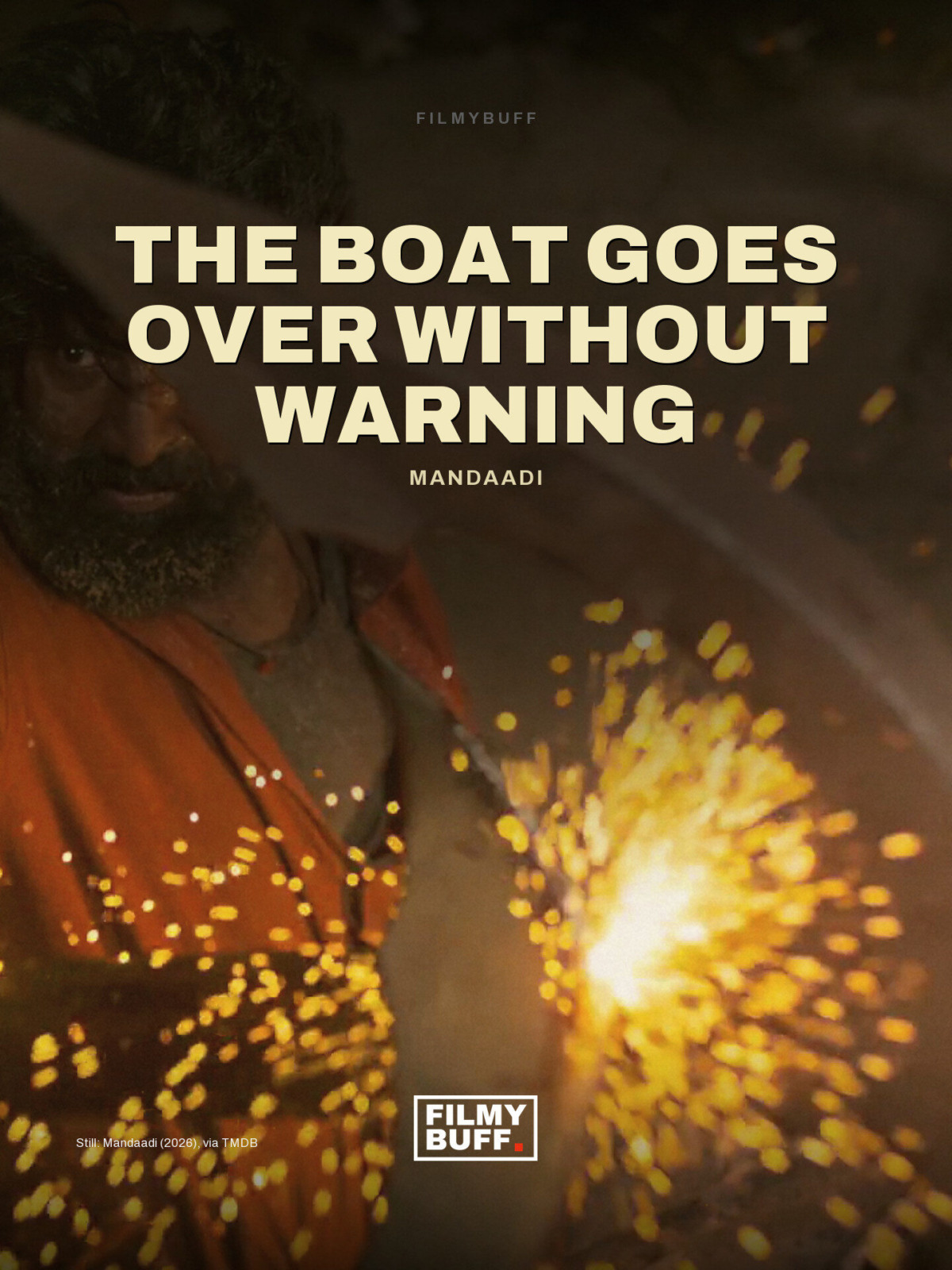
The boat flip in Mandaadi arrives like a held breath being slapped out of you. I have watched it four times now, and the moment still makes my stomach drop.
1. The setup: where the scene sits in the film and what is at stake
By this point, the group is already far from shore, and the crossing has been too calm for too long. The scene sits just past the midpoint, after tensions below deck have made everyone forget the water. What is at stake is simple: one boat, too many people, and an ocean that does not care.
2. The turn: the beat where the scene changes gear, and how the film gets there
The turn is not the flip itself; it is the half-second of silence just before. A rope gives, the hull groans, and the film withholds the crash for one terrible beat. The scene changes gear from cramped-boat drama to open-water survival without a cut to the sky or a score swell—just physics and panic.
3. The line: the line or the moment people quote, and why it lands
The line that travels from this scene is a single shouted word—“Hold!”—yelled not once but three times, faster each time. It lands because the writing has already taught us that holding the boat means staying alive; the timing makes it an action before it is a plea, and the delivery is hoarse, practical, and terrified all at once. Fans quote it because it is the whole scene compressed into one syllable.
4. The performance: what the actor or actors do, precisely, that a lesser scene would not
What sells the panic is how unheroic everyone looks. The actor playing the boatman does not stand and point; he scrambles sideways on all fours, one arm already tangled in rope. The younger passenger does not scream first—he freezes, mouth open, and only moves when a wave smacks him. In a lesser scene, everyone would flail on cue. Here, the actors keep their weight low, grab for anything fixed, and look genuinely surprised by their own breathing. That physical uncertainty is the performance.
5. The craft: the staging, the cut, the music, the sound, the camera, whichever carries it, with one specific choice named for each you mention
The craft that carries this is sound and staging. On staging, the film shoots the flip from inside the boat, so we see the world become ceiling before we see the water—one specific choice is the cargo net that swings across the lens and stays there. On music, the score drops out completely for about twenty seconds; all that remains is the crack of timber, a wet slap, and someone’s breathing. The cut stays long enough to let bodies slide, not just splash. The camera tilts with the boat rather than cutting to a wide, keeping us inside the confusion. Each choice is specific: the net, the silence, the long take, the tilt.
6. Why it travels: why this scene is the one people share, decades or days later
This scene travels because it feels like an accident you shouldn’t be watching. It is short, visual, and instantly legible even with the sound off; someone can share it as a reaction to a bad day, a spoiler-free flex, or a promise that the film does not play safe. The panic is real enough to make you hold your phone with both hands.
Watch the original: Netflix India on YouTube. Shown for review and comment; the rights stay with the makers.