The setup
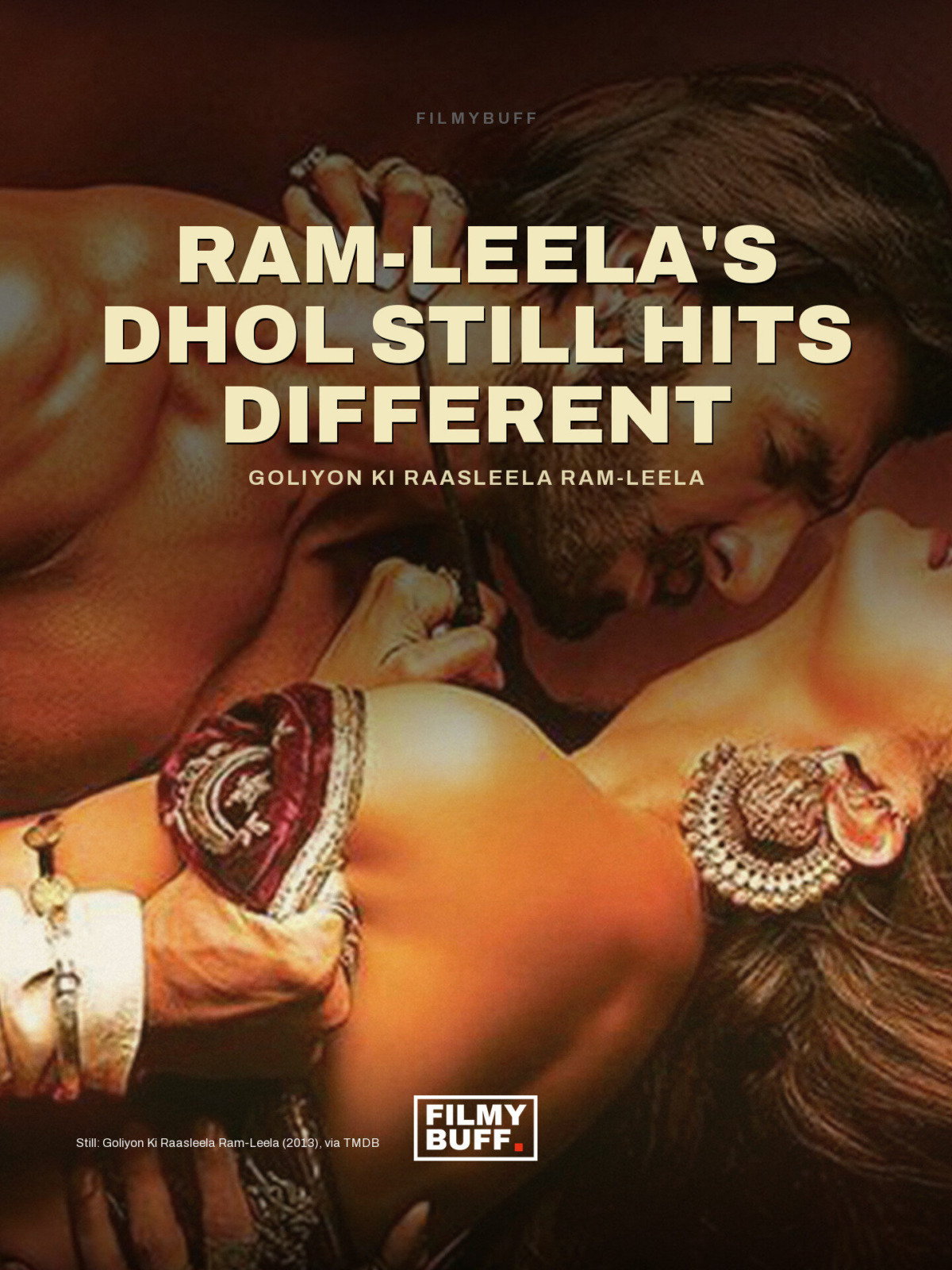
This arrives early in Goliyon Ki Raasleela Ram-Leela, once Ram and Leela have already made clear that their families’ war runs hot and their attraction runs hotter. At a Navratri celebration, the whole town is in the courtyard, and every step they take together reads as both a courtship and a provocation. There is no private moment here; the danger is that everyone is watching.
The turn
The number starts as spectacle: a vast, symmetrical courtyard of dancers moving as one. The gear change is Leela’s entrance. The crowd parts, the rhythm pauses around her, and she turns into the dance not as a participant but as the person who owns it. From that beat, the garba stops being a festival and becomes a face-off—Ram’s grin says he knows he has stopped leading.
The line
Nagada sang dhol baaje, dhol baaje.
The phrase is its own percussion line. “Nagada” and “dhol” land like two different drums, and the repetition of “dhol baaje” gives Shreya Ghoshal a hook that feels less sung than beaten out. Osman Mir’s earthy answer under it keeps the line folk-rooted rather than filmy-slick, which is why it sticks.
The performance
Deepika Padukone gives Leela a raised chin, an almost military precision in her wristwork, and a smile that never softens her eyes. She dances the traditional steps cleanly, but she aims them at Ranveer Singh like a dare. Ranveer, in turn, stays joyfully undone: loose shoulders, claps a fraction late, teeth out, as if Leela has pulled him into her rhythm and he is happy to be caught. A lesser version would have them simply dancing well together; this one is a duel disguised as a duet.
The craft
The staging uses one huge symmetrical master shot to establish the courtyard, then never fully returns to it, so the dance feels both communal and tightening. The camera’s slow push-in on Leela’s first turn makes her arrival feel like a decision, not choreography. The cut snaps on the dhol’s downbeat rather than on every step, which gives the movement a pulse. The sound keeps the dhol’s low thump slightly forward in the mix, so the beat sits in the chest, and the music answers Shreya’s vocal line with a short shehnai phrase that stops the song from becoming too polished.
Why it travels
This is the scene people share because it bottles the film’s whole promise: two gorgeous, fully committed leads, a giant Bhansali set, and a folk hook that needs no translation. The new 4K upgrade gives fans an excuse to pass it around again, but the reason it lasts is simpler—it looks like a celebration and feels like an argument, all at once.
Watch the original: Sony Music India on YouTube. Shown for review and comment; the rights stay with the makers.