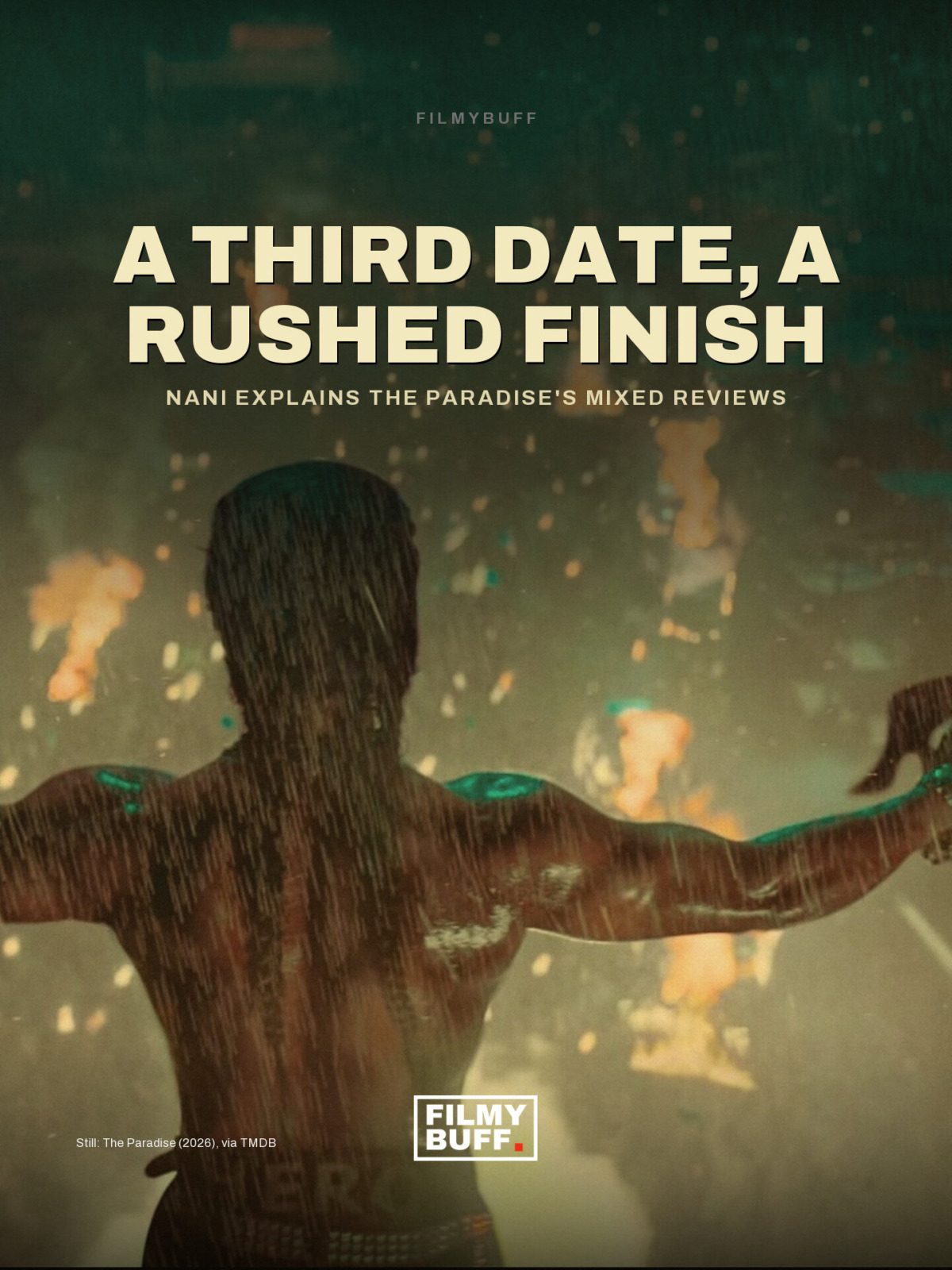
When a star opens up about a polarising film, the usual move is to defend the numbers or credit the audience. Nani has chosen a rarer path: he has spoken candidly about the craft behind The Paradise.
The response to The Paradise has been divided since its worldwide release on September 24. Some praised its ambition and Nani’s transformation; others felt the film had visual firepower without a clear emotional thread. Now the actor has added his own reading of what went wrong.
Nani’s honest postmortem
The period action drama was already on its third announced release date when it hit theatres. Speaking to The Hollywood Reporter India, Nani said the team did not want to disappoint an audience that had waited through multiple postponements.
“More things would have made sense narratively with the edit and the score, if we had more time,” he said.
He added that there is no way to know whether another delay would have changed the film’s reception. His rule is simpler: understand the mistakes, learn from them, and move forward.
Where the focus shifted
Nani also traced the problem to scale. As The Paradise grew bigger and expectations climbed, director Srikanth Odela’s attention moved from storytelling to set pieces. “So, the connectivity wasn’t there,” Nani said. He called the filmmaker “very, very original” but said the larger vision got diluted while the film was stitched together.
Nani’s framing is not about blame. He is describing a common trade-off in big-canvas filmmaking: when the span of a film goes up, a director can begin solving for spectacle before clarity. For The Paradise, that meant the connectivity between ideas suffered even when individual set pieces impressed.
How to read the mixed response
- Check the connective tissue: does a scene build character, or is it designed mostly for scale?
- Listen to the edit and score: pacing and music often reveal where a film was rushed.
- Separate vision from execution: a director’s originality can remain even when the final cut doesn’t fully land.
The Paradise is Nani and Srikanth Odela’s second collaboration after Dasara. Produced by Sudhakar Cherukuri under the SLV Cinemas banner, the film is set in 1980s Secunderabad, with Nani playing Jadal, a leader from the marginalised Savaari community.
For Telugu cinema fans, this is less an excuse and more a rare window into how release pressure, scale and editing choices shape a film’s final form.
Source: bollywoodHungama.com