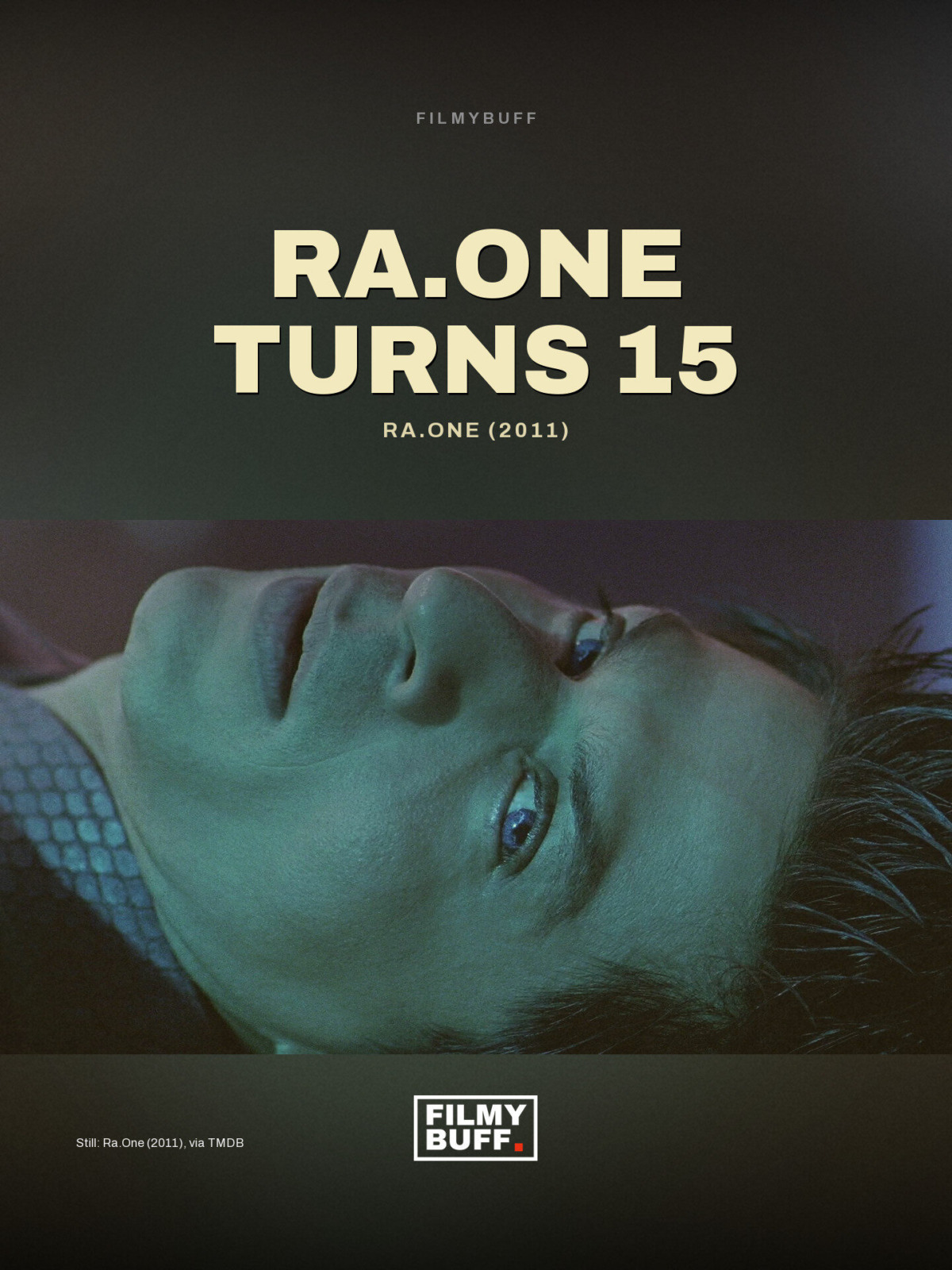
Fifteen years on, Ra.One remains a genuinely ambitious swing for Indian superhero cinema. Before the self-learning AI, the H.A.R.T and the cube-shattering action, it started with a television commercial and a very big leap of faith.
It began with a TV ad
According to director Anubhav Sinha, the idea of Ra.One originated in 2005 when he saw an advertisement on television which showed children remotely controlling a human. He was attracted to the concept and wrote a script based on it. Sinha then approached Shah Rukh Khan, who liked the story and decided to produce the film under his production company Red Chillies Entertainment.
Shah Rukh Khan saw it as a modern Raavan
“Ra.One is the modern, new age technology version of our mythological ‘Raavan’, who was a mixture of ten different evil characters. I am essaying the role of G.One or better say ‘Jeevan’, a superhero who saves the mankind from Ra.One’s torment. Through this film, I want to prove that Indian superheroes can also be as cool as the international ones.”
That was Shah Rukh Khan on the film’s ambition, and it set the tone for everything that followed.
Kareena Kapoor insisted her way in
Kareena Kapoor, Priyanka Chopra and Asin had initially been considered for the lead female role. Kareena Kapoor was ultimately chosen because she insisted on playing the part. Arjun Rampal accepted the role of Ra.One after Anubhav Sinha expressed a strong desire to cast him in the film.
The casting had a few near-misses
Jackie Chan had initially been approached for the role of Aakaashi, but he declined the offer. Rajinikanth suffered from health problems which caused a delay in the filming of his cameo appearance. Sanjay Dutt faced a scheduling conflict with Agneepath (2012), which was later resolved. Arjun Rampal also encountered back problems, prompting speculation of a possible replacement by Vivek Oberoi.
The leads trained through the pain
Several cast members prepared extensively for their roles. Rampal and Kapoor followed special diets to lose weight, while Khan and Verma performed their own stunts and Kapoor subsequently did so as well despite initial reluctance. Khan faced difficulties with his superhero suit and prosthetic makeup, and injured his left knee.
Miami was the first dream, until budget cut in
Principal photography was initially set to begin in Miami, but the idea was abandoned due to budget constraints. The first phase of filming began in Goa on 21 March 2010 and continued until May. The second and third phases took place in London with the entire cast, beginning in July 2010 and ending in August.
The 3-D conversion was its own industry
The idea for converting the film to 3-D was put forth during filming and implemented in July 2011 due to a revived interest in 3-D films. The process required 2,600 artists to convert 4,400 shots of the film. Prime Focus carried out the 3-D conversion, with sound enhancements achieved using the Dolby Surround 7.1 system.
The finish line was painfully tight
Incorporating the visual effects began in April 2010, and 1,200 artists worked for 2 1/2 years to complete the visual effects work. Complex procedures included cubical transformations and the design of the faceless form of Ra.One. The delays left only two days for printing the film and sending it to theatres, so Shah Rukh Khan kept strict tabs on progress and postponed his knee surgery to complete the film on time.
That closing race, more than anything, is the Ra.One story: enormous visual ambition, held together by a very human crunch. What is the detail from its making that you still remember?
Facts from Wikipedia: Ra.One, available under CC BY-SA 4.0.
Film images from TMDB. This product uses the TMDB API but is not endorsed or certified by TMDB.