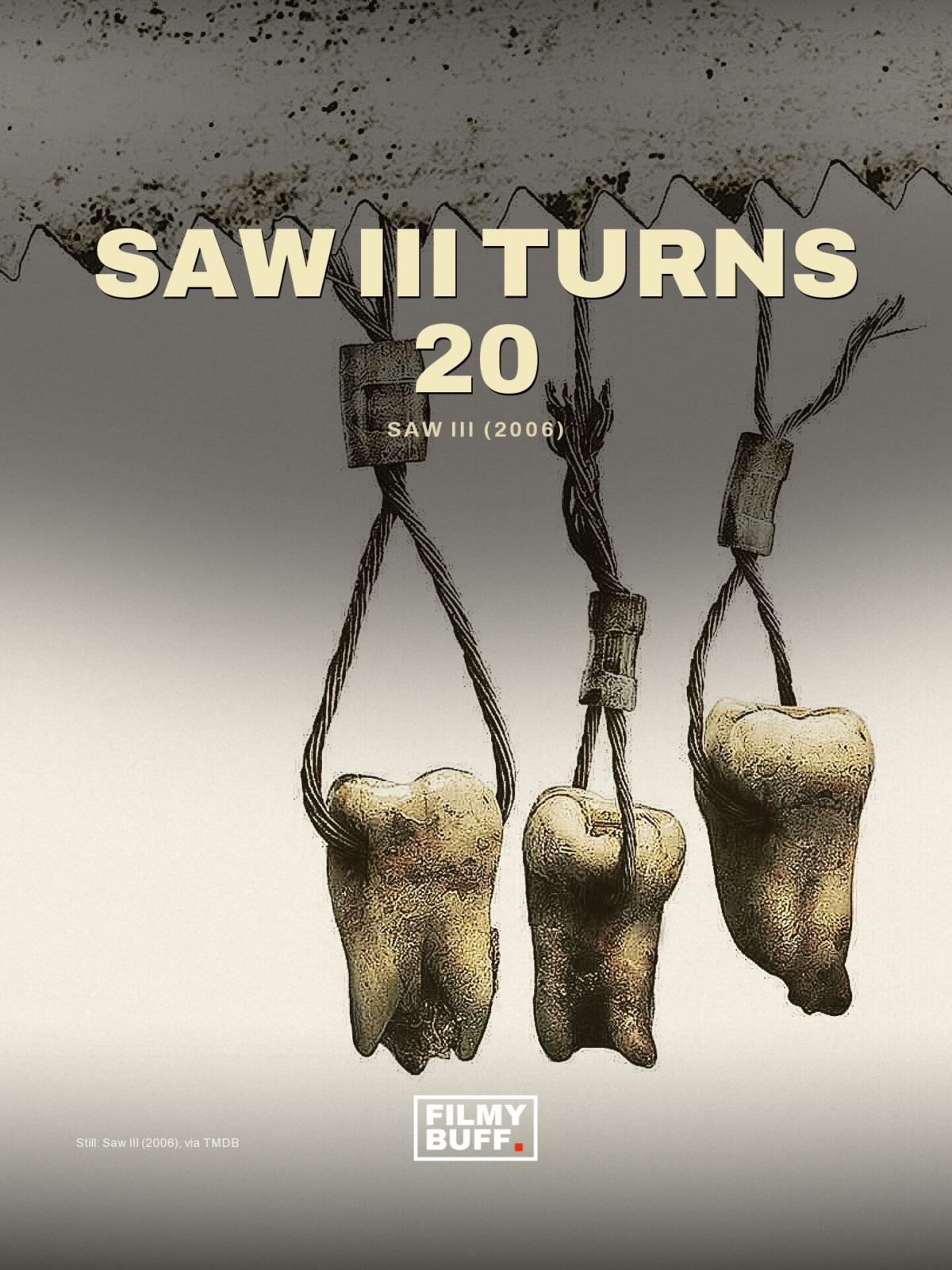
Saw III turns 20 this week, and the third chapter still feels like the moment the franchise learned how to go bigger without losing its grip. The traps were gnarlier, the budget grew, and the marketing went somewhere no poster campaign had gone before. We went back through the production to find nine details even devoted Saw fans may have missed.
The posters were printed with Tobin Bell’s blood
Lionsgate’s president of theatrical marketing Tim Palen had an idea that sounded like a dare: put actual blood in the poster ink. He asked if it was possible. “There was silence. He said, ‘We could try, but are you serious?’ I said I was dead serious.” The studio made 1,000 posters with a small amount of Bell’s blood mixed into the printing ink, sold them for $20, and auctioned the first one, donating the auction proceeds to the Red Cross.
The team turned it down, then made it for Gregg Hoffman
Darren Lynn Bousman, James Wan, and Leigh Whannell all initially turned down the offer to make a third film. Producer Gregg Hoffman died a few weeks after the previous film’s release, and the three met for lunch the day they heard the news. They decided to make Saw III in dedication to Hoffman.
The script was stolen, then quietly returned
At one point the script was stolen from Bousman’s chair. It was returned before it leaked online, so the ending stayed under wraps.
Whannell wrote it as a father-daughter love story
Leigh Whannell aimed to make this sequel more emotional, describing the plot as essentially a father-daughter “love story” between John Kramer / Jigsaw and Amanda Young. Bousman said they did not intend a twist ending as distinctly as the previous films, adding, “I think most people will figure it out in the first 15 minutes of the film.” Whannell added that the goal “was to have an emotionally impactful ending.”
Only the final-scene actors got the ending
Keeping the ending secret was the rule. As with the previous two films, the ending was only given to the actors who appeared in the final scene at the time it was filmed.
Bahar Soomekh had nightmares for a month
After Bahar Soomekh appeared in Crash, Lionsgate wanted her in the next Saw film, and she landed the role of Dr. Lynn Denlon. She was not a horror fan and had not seen the first two films, which made the part a challenge. “I had nightmares the first month I was on set,” she said. She did enjoy not being typecast as a Middle Eastern character.
A bigger budget, a 27-day Toronto shoot
Saw III was given a larger budget of $10 million, compared to Saw II’s $4 million. Principal photography took 27 days at Toronto’s Cinespace Film Studios from May 8, 2006, to late June.
The bathroom set was borrowed from Scary Movie 4
Production borrowed the bathroom set used in Scary Movie 4, the comedy that had parodied the franchise. Visually, the film stayed in the family style: quick cuts, whip pans, and flash frames created the dynamic feel Bousman wanted.
It ruled home video with 2.5 million units
When Saw III hit DVD and Blu-ray on January 23, 2007, it topped the home video charts in the United States and Canada. It moved 1.6 million units on its first day and finished the week with 2.5 million units sold. The same day’s unrated edition ran 113 minutes with more gore, and a 120-minute director’s cut came in October 2007.
Which of these Saw III details do you still think about? Tell us your own favourite fact from the traps to the twist.
Facts from Wikipedia: Saw III, available under CC BY-SA 4.0.
Film images from TMDB. This product uses the TMDB API but is not endorsed or certified by TMDB.