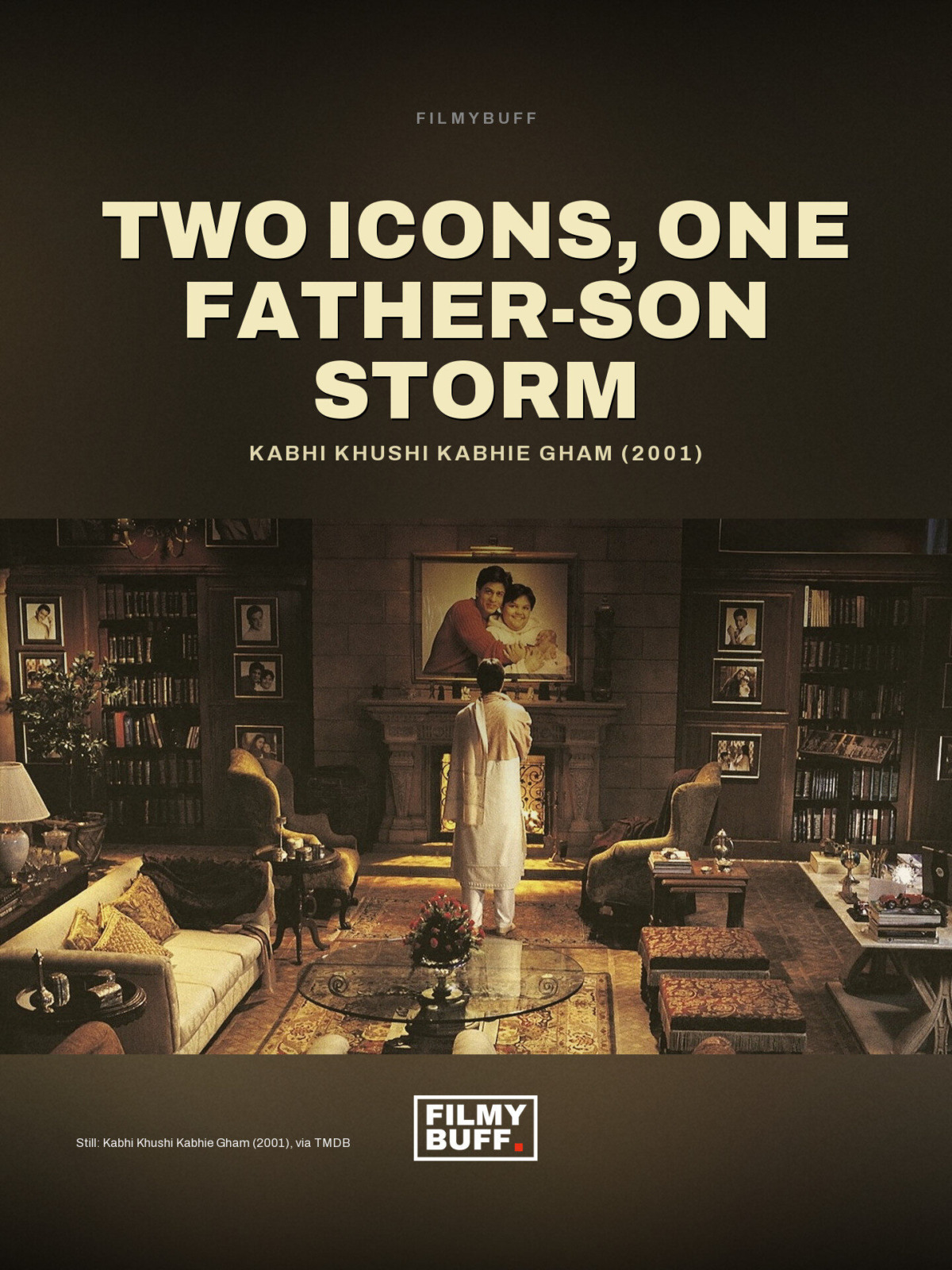
Karan Johar’s Kabhi Khushi Kabhie Gham is a film of manicured lawns and outsized feelings, but this London scene removes the gloss. It is just a father and son, in a room, with years of silence between them.
The setup
Rahul has been cut off from the Raichand family for marrying Anjali, and he has built a warm, modest life in London. Yashvardhan arrives without warning, and the moment he steps inside, both men have to decide whether this is a visit or a verdict. The stakes are not the family business or the house in India; it is whether a father can see his son as anything but a betrayal.
The turn
The scene starts with Rahul’s nervous formality and Yashvardhan’s imperial stillness. Then the camera stops cutting away from the anger. The turn is when Yashvardhan stops issuing statements and starts asking questions a father should ask, not a patriarch. The room suddenly becomes smaller, and the film lets the two actors carry the gear change with their breathing.
The line
“Baap baap hota hai” is the line that lands hardest because it is not an apology. It is a surrender disguised as a law of nature. Bachchan delivers it not as dialogue but as a fact the character has been fighting for years.
The performance
Shah Rukh Khan does the harder job: Rahul is the one who has already lost, so he cannot lash out. He keeps his shoulders up and his voice polite until the hurt breaks through. Bachchan, by contrast, barely moves; it is all in the jaw and the pauses. A lesser actor would shout the entire scene. These two know the shouting is the release, so they ration it.
The craft
The staging keeps Rahul standing just inside the door, never fully welcome in his own home. The camera uses a slow push-in on Yashvardhan as his certainty cracks. The music drops away at the first exchange and lets the room tone do the work. The cut holds on Rahul’s face a beat longer than expected before the father’s reaction. One specific choice: the low-angle shot on Bachchan early on, then the switch to eye-level when he finally listens.
Why it travels
The scene travels because it is the film’s entire argument in one room: tradition and love are not the same thing, and one of them has to blink. Fans share it decades later because it gives the two biggest stars of the era space to be quiet, and the quiet is the storm.
Watch the original: Dharma Productions on YouTube. Shown for review and comment; the rights stay with the makers.