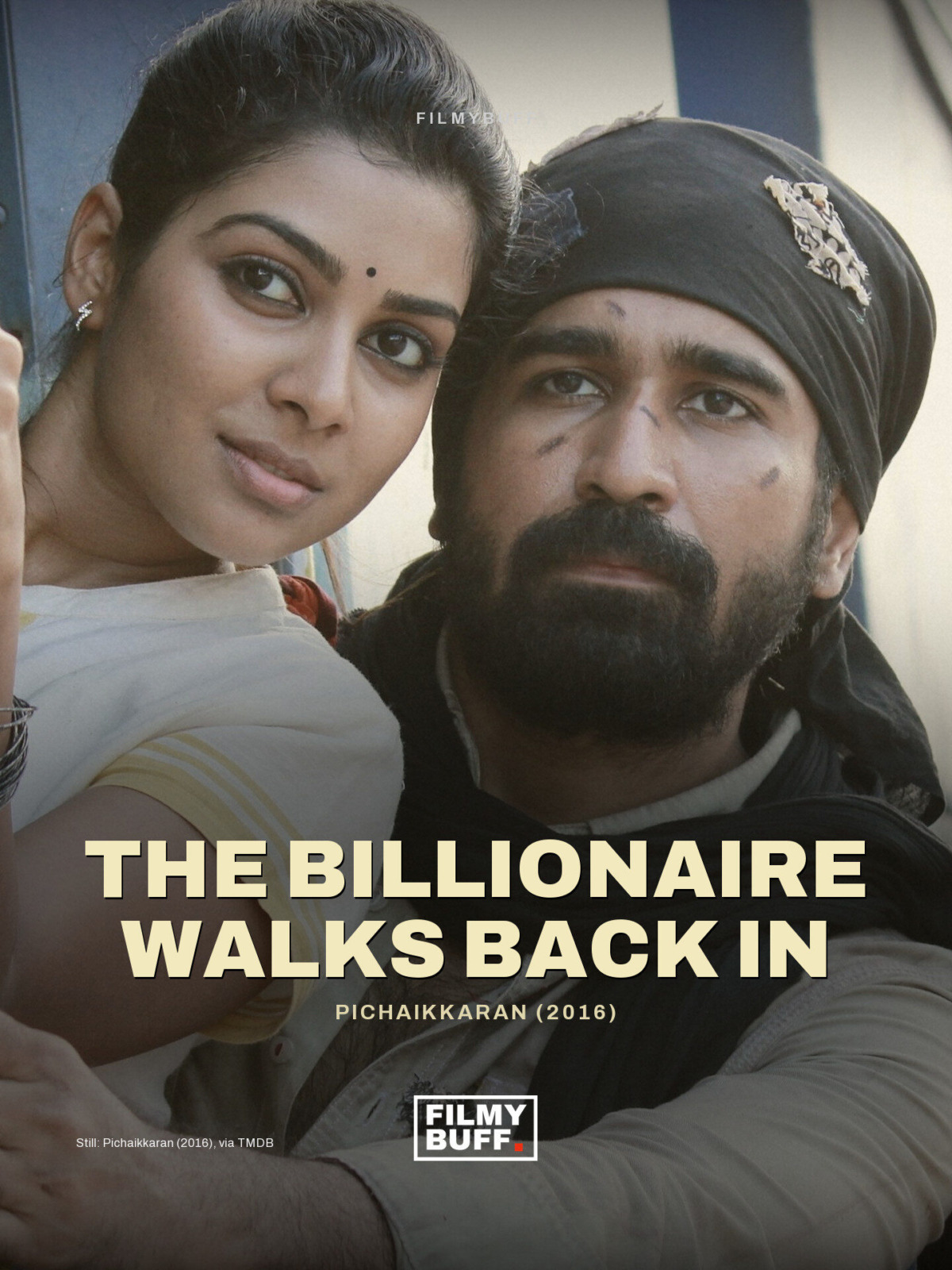
1. The setup: where the scene sits in the film and what is at stake, in two or three sentences, no spoilers beyond it.
By this point, Arul has spent long enough on the street that the man in rags feels like the film’s default image of him. The scene arrives as the promise the title has been holding back: the beggar has not disappeared; he has been waiting to walk back into his own life. What is at stake is not just a costume change, but whether power can simply be put back on.
2. The turn: the beat where the scene changes gear, and how the film gets there.
The gear shift is visual, almost musical. The film leaves behind the grimy, crowded street palette and replaces it with clean lines, cool light and a taller frame for Arul. The moment he removes the outer layer of the disguise, the editing stops behaving like a survival drama and starts behaving like an entrance sequence.
3. The line: the line or the moment people quote, and why it lands (the writing, the timing, the delivery).
There is no big speech here, and that is why the scene works. The quotable moment is a gesture: the pause before he steps forward, the deliberate adjustment of a cufflink or the slow donning of shades. It lands because the film trusts the audience to read the return without underlining it with dialogue.
4. The performance: what the actor or actors do, precisely, that a lesser scene would not.
Vijay Antony keeps his face almost still, but changes the carriage of his shoulders and the weight of his walk. He does not celebrate; he simply inhabits the old entitlement again. A lesser scene would have him slow-motion grin at the camera. Here, the restraint makes the transformation feel earned rather than cartoonish.
5. The craft: the staging, the cut, the music, the sound, the camera, whichever carries it, with one specific choice named for each you mention.
The staging uses a long horizontal walk to let each new detail register. The cut is built on hard beats: coat, shoes, watch, sunglasses, each landing as a separate shot. The camera drops low to make the re-emerging Arul look monumental, and the sound design pulls the street noise down so the score can push through cleanly. The music choice that carries it is a pulsing electronic thump that enters on a footstep, turning the scene into a processional.
6. Why it travels: why this scene is the one people share, decades or days later.
It travels because it is the moment the film flips its own emotional contract. Fans share it as a self-contained star image: a man walking back into wealth with complete swagger. You do not need the previous hour to understand what the sequence is selling, and that clarity makes it endlessly shareable.
Watch the original: Sun NXT on YouTube. Shown for review and comment; the rights stay with the makers.