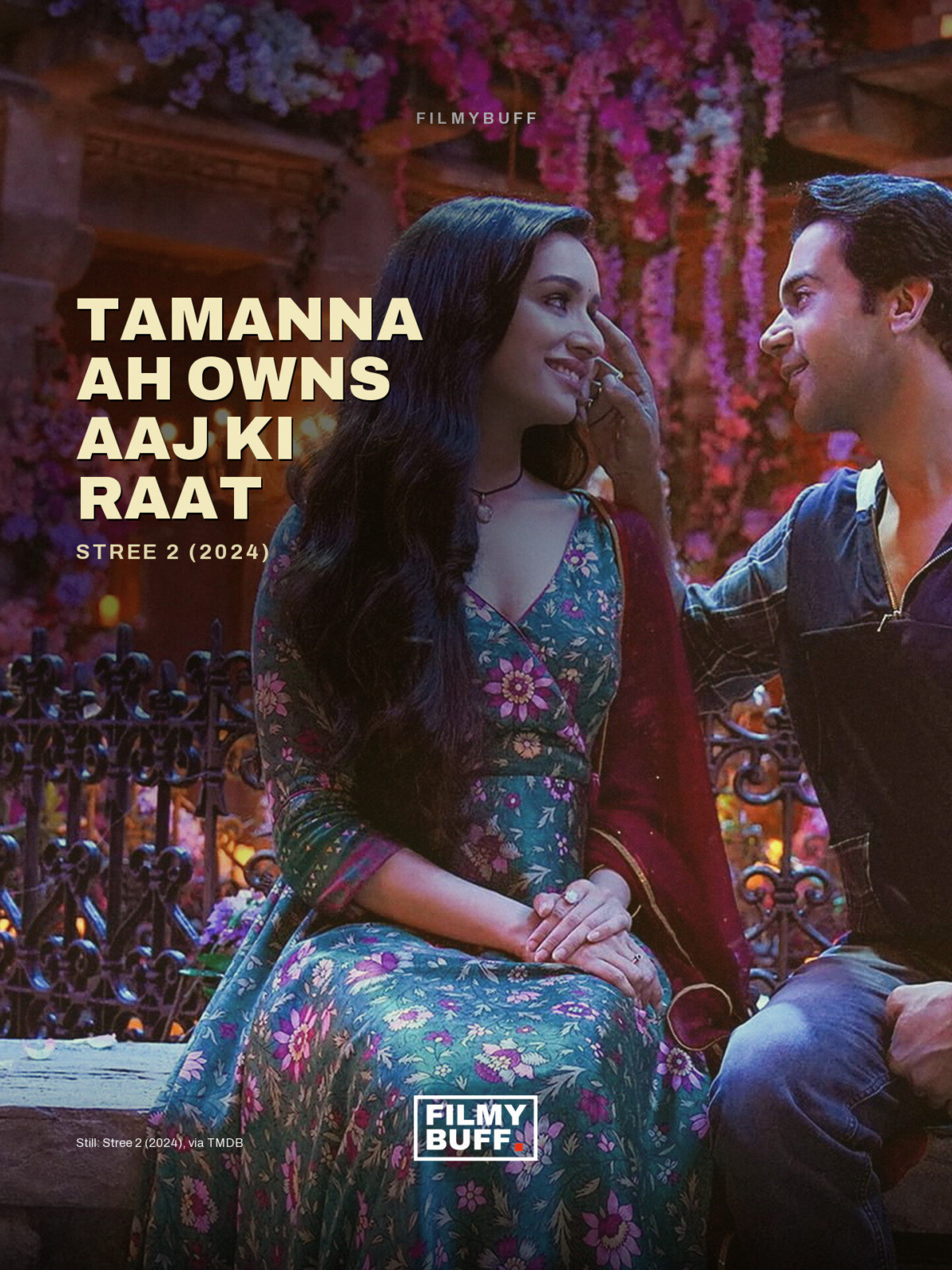
I have watched Aaj Ki Raat more times than I care to admit, and every time the same thing happens: the vocals drop, the bass kicks, and Tamannaah Bhatia takes over the frame like she owns the building. Not the stage—the entire club.
The setup
By the time the song drops in Stree 2, Chanderi is living under a new fear, and Vicky and his friends are in over their heads again. The club is a pit stop, not a party; there is a job hiding inside the neon. That low-key dread is what makes the song work: it gives the audience permission to cut loose for four minutes while knowing the film is still circling something darker.
The turn
The turn is not a story beat, it is a bass drop. Sachin-Jigar’s track pulls back for half a breath, the crowd noise dips, and Shama starts walking rather than dancing. The first hook step lands before the chorus can explain itself, and the crowd—and then Vicky—mirror her. In that beat, the scene changes from performance to ritual.
The line
“Aaj ki raat, kuch hone ko hai.” It is a warning, an invitation, and a promise folded into one line. Because Madhubanti Bagchi and Divya Kumar deliver it half-spoken over the rhythm, it does not sound like a lyric; it sounds like a dare. That is why it travels: it is declarative enough to be a caption and loose enough to be an inside joke.
The performance
Tamannaah’s control is the whole scene. She does not rush; she rolls a shoulder, resets her eye line, and lets the camera come to her. A lesser version would have her doing more. Rajkummar Rao’s comic brilliance is in the opposite energy—he copies the step too eagerly, a fan who knows he is out of his depth, and his timing makes the crowd’s imitation feel earned rather than choreographed.
The craft
Staging does the heavy lifting: the club is arranged as an amphitheater, so the crowd is the foreground and Tamannaah is the fixed point. The cut that matters is the hard snap on the bass drop, from her face to her feet, which announces the hook as the main event. The camera also earns it: a low-angle push-in follows her first step forward, making her presence feel taller than the room. The 8K upload finally lets that detail breathe—the glancing eye contact, the fabric, the distance between her stillness and everyone else’s movement.
Why it travels
Because the scene gives people a move, a line, and a feeling they can reuse. It is not just a song; it is a takeover you can learn in 10 seconds. Fans share it because Tamannaah makes minimal movement look like maximum power, and because Stree 2 knows exactly when to stop explaining and let her step forward.
Watch the original: Saregama Music on YouTube. Shown for review and comment; the rights stay with the makers.