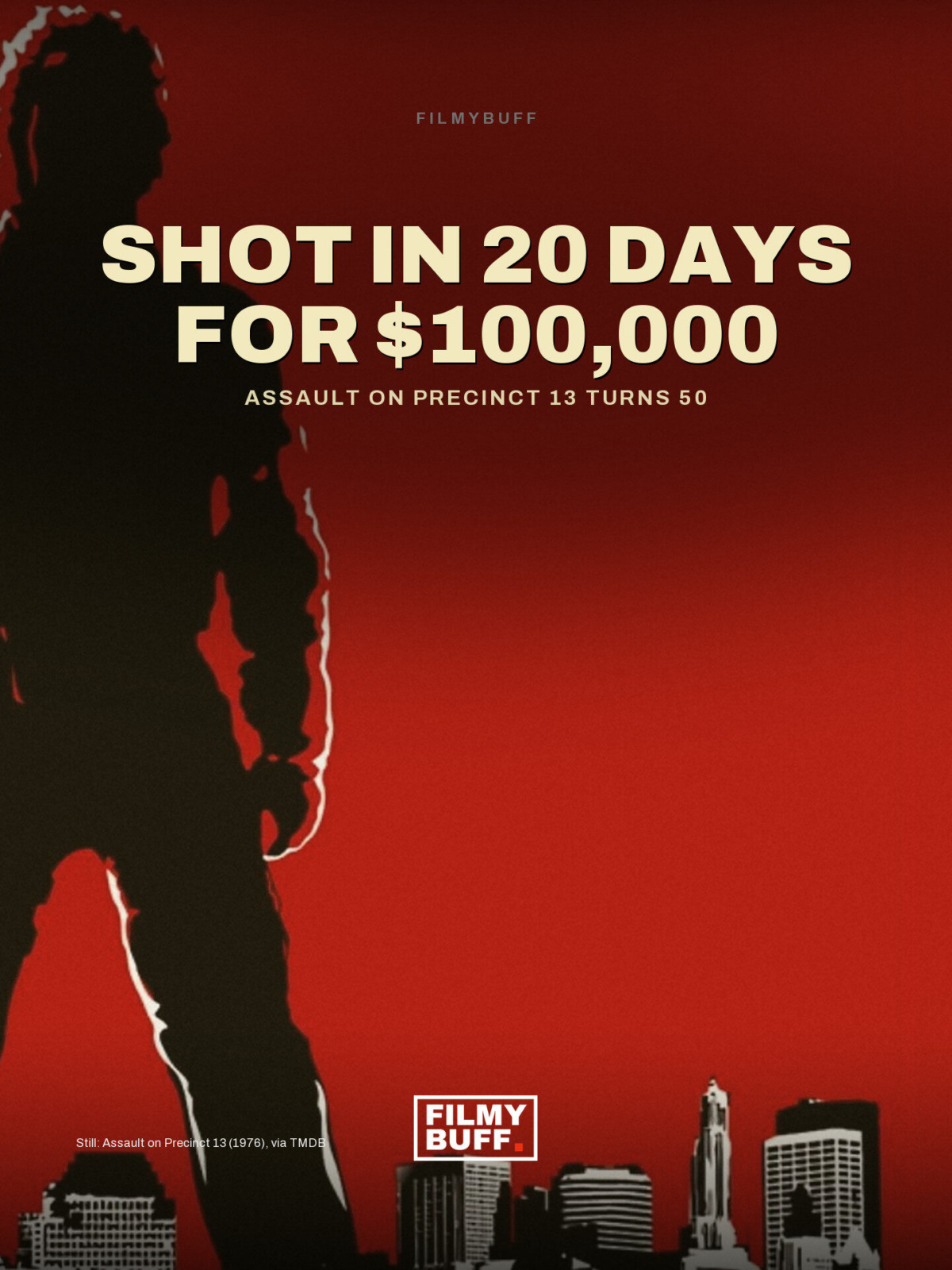
This week, Assault on Precinct 13 turns 50, and the making of John Carpenter’s 1976 siege thriller is still a masterclass in doing more with less. Written, directed, scored and edited by Carpenter, the American independent action-thriller follows Austin Stoker as a police officer defending a defunct precinct against a relentless criminal gang, with Darwin Joston as a death row–bound convict who assists him.
But the backstory is the real attraction: a film shot in 20 days for $100,000, with a crew learning on the job, a closed freeway doubling as a location and dailies projected on a bedsheet.
Two scripts, one film left in the race
After the release of Dark Star, Assault and a second script called Eyes were supposed to be two low-budget films written and directed by John Carpenter with financing by J. Stein Kaplan. When Eyes was sold to Barbra Streisand and Jon Peters and later renamed Eyes of Laura Mars, Kaplan and Joseph Kaufman concentrated on just Assault.
Family money forms the CKK Corporation
“J. Stein Kaplan was a friend of mine from USC,” Carpenter said. “He knew Joseph Kaufman from his days in Philadelphia … Basically their fathers were funding Assault on Precinct 13.” The two families of the producers formed the CKK Corporation to finance the film.
A cast found next door and in open calls
Carpenter assembled a main cast of mostly experienced but relatively obscure actors. Darwin Joston had worked primarily in theatre and television and was also Carpenter’s next-door neighbour; Austin Stoker had appeared in Battle for the Planet of the Apes and Sheba, Baby. Veteran Western actor Henry Brandon, notably of The Searchers, played Cheney, and Tony Burton was cast partly due to his own prior stint in prison for armed robbery. An open casting call added Charles Cyphers and Nancy Loomis.
A green crew and key storyboards
Behind the scenes, Carpenter worked with cinematographer Doug Knapp, art director Tommy Lee Wallace, sound mixer Bill Varney and property master Craig Stearns. Wallace said, “I hardly knew what the job required … but he believed in me, and, of course my price was right.” Carpenter drew storyboards for key sequences, including the ice cream truck sequence and the failed escape by prisoner Wells.
Twenty days, Thanksgiving included
Assault started in November 1975 and was shot in only 20 days, including Thanksgiving, on a budget of $100,000. The film was shot on 35-mm Panavision in a 2.39:1 anamorphic aspect ratio on Metrocolor film stock, and was Carpenter’s first experience with Panavision cameras and lenses. He has referred to the film as the most fun he has ever had directing.
Real jails, a closed freeway and USC students
Two weeks of shooting indoors were followed by two weeks on location. Interiors were shot on the now-defunct Producers Studios set, while exterior shots and jail cells came from the old Venice police station. The bus travelling to Sonora was shot on a closed section of the Los Angeles freeway system, with cast and crew having lunch on the freeway. Carpenter’s low-budget philosophy was to shoot as little footage as possible and extend scenes for as long as he could.
Dailies that looked like a zillion dollars
The first scene, in which gang members are gunned down by cops, was shot at USC with USC students playing the gang. “The first night I saw dailies,” Wallace said, “projected on a bedsheet in the producer’s ratty apartment… My jaw dropped and I sat up so straight I cast a shadow with my head. This looked like a zillion dollars. This looked like a real movie.”
Bare-bones editing, one dark mistake and a sound splurge
Carpenter edited the film under the pseudonym John T. Chance, with Debra Hill as assistant editor. He called the editing process bare-bones and was not proud of one shot “cut out of frame.” It happened because Assault was shot on Panavision, which takes up the entire negative, and edited on Moviola, which cannot show the whole image. “It was so dark, no one could see it, thank God!” he said. Wallace also recalled Carpenter insisting on the best processing and post-production sound money could buy—the MGM color labs and Samuel Goldwyn Sound—an unorthodox approach that ate up a huge amount of the budget.
From family financing to freeway lunches and bedsheet dailies, the making of Assault on Precinct 13 is full of details worth keeping. Which one of these 50-year-old production stories is your favourite?
Facts from Wikipedia: Assault on Precinct 13 (1976 film), available under CC BY-SA 4.0.
Film images from TMDB. This product uses the TMDB API but is not endorsed or certified by TMDB.