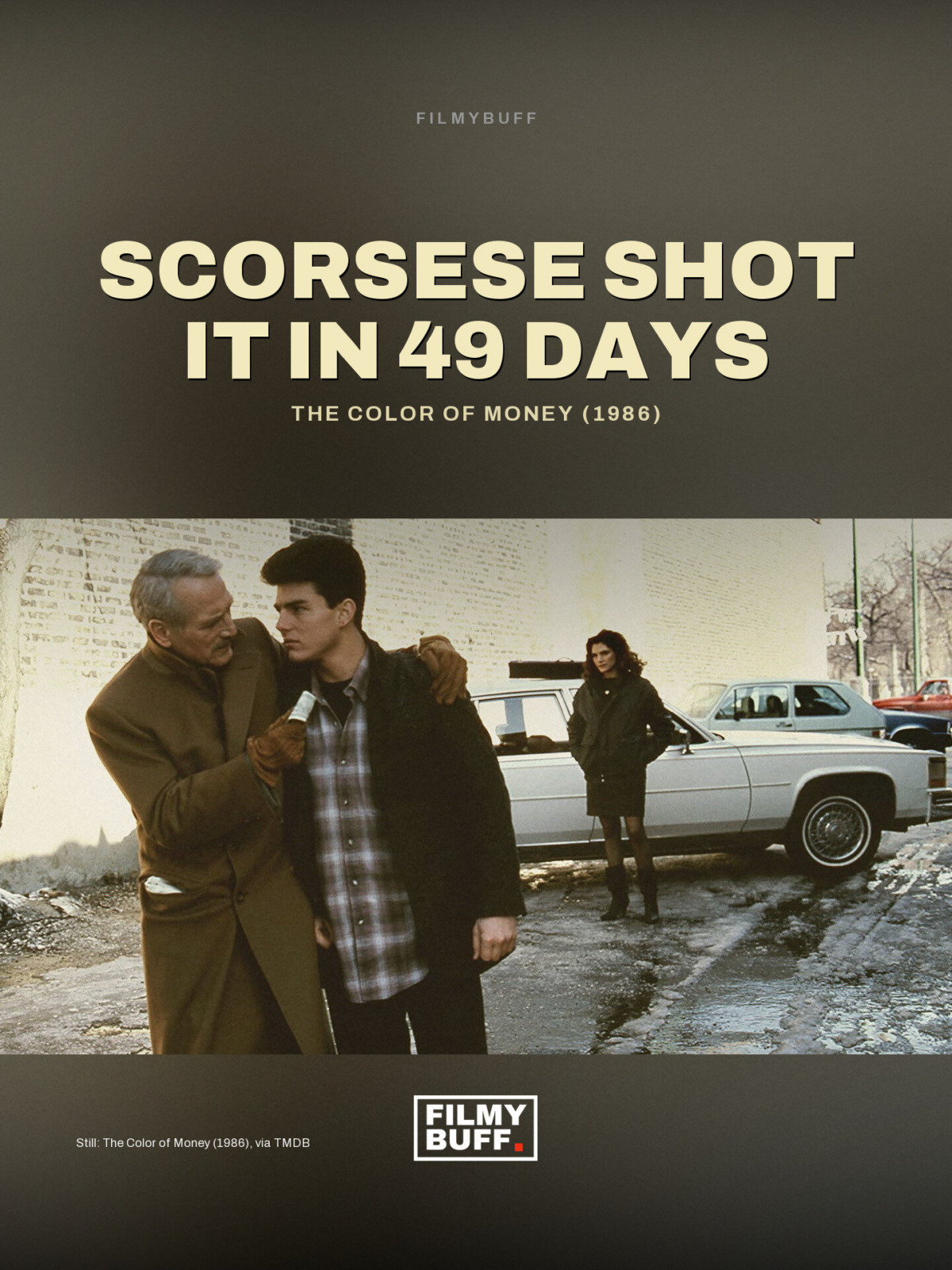
This week, The Color of Money turns 40, and the details around it are as rewatchable as the pool games. Martin Scorsese’s 1986 drama put “Fast Eddie” Felson and Vincent Lauria together on the road through Chicago pool halls, and it carried Paul Newman to his first Academy Award. Behind the scenes, it was a film of quick decisions, borrowed visuals and a cue stick that was not what it seemed.
1. The first call came from Newman
Paul Newman called Martin Scorsese in September 1984 and asked if he was interested in directing a sequel to The Hustler. The script that first went to Scorsese was written by Darryl Ponicsan and, as Scorsese put it, “incorporated the first twelve minutes of the original film.”
2. The author died the day the book arrived
Walter Tevis wrote a sequel to his novel The Hustler, called The Color of Money. He died the same day producer Irving Axelrad received galley proofs of the book. Richard Price later adapted Tevis’s novel, although the film was not written to be a sequel.
3. A 49-day shoot, under budget
Scorsese shot the film in 49 days at a cost of $14.5 million, which came in $1.5 million under budget. Michael Ballhaus was the cinematographer and Thelma Schoonmaker edited. Much of the filming took place in and around Chicago, in pool and billiard halls rather than built sets, including FitzGerald’s Nightclub.
4. Cruise did almost every shot himself
Tom Cruise bought a pool table for his apartment and practiced for hours on end. He performed most of his own pool shots. The exception was a jump shot over two balls, which professional player Mike Sigel performed because Scorsese believed it would take too long for Cruise to learn it.
5. Black Narcissus inspired the closeups
Scorsese considered shooting the film in black and white. He cited the techniques and lighting of the 1947 Powell-Pressburger film Black Narcissus as an influence, and said the extreme closeups of Tom Cruise around the pool table were inspired by those of the nuns in that film.
6. Scorsese’s note was “try not to be funny”
Paul Newman said the best advice Scorsese gave him was to “try not to be funny”. His performance received positive reviews and earned him the Academy Award for Best Actor, his first Academy Award and seventh nomination.
7. The Balabushka was a stand-in
Standing in for the valuable Balabushka cue in the movie is a Joss J-18, which became the Joss 10-N7. It was made to resemble a classic Balabushka.
8. Fox and Columbia passed
The Color of Money was released by Touchstone Pictures after both 20th Century Fox and Columbia Pictures declined. It had its world premiere at the Ziegfeld Theater in New York City on October 8, 1986, and went into wide release in the United States on October 17, 1986. After its run, the film grossed $52,293,982 domestically.
That mix of near-black-and-white lighting, real pool-hall locations and a disguised cue gives the film a texture that still rewards a close look. Which of these eight details surprised you most?
Facts from Wikipedia: The Color of Money, available under CC BY-SA 4.0.
Film images from TMDB. This product uses the TMDB API but is not endorsed or certified by TMDB.