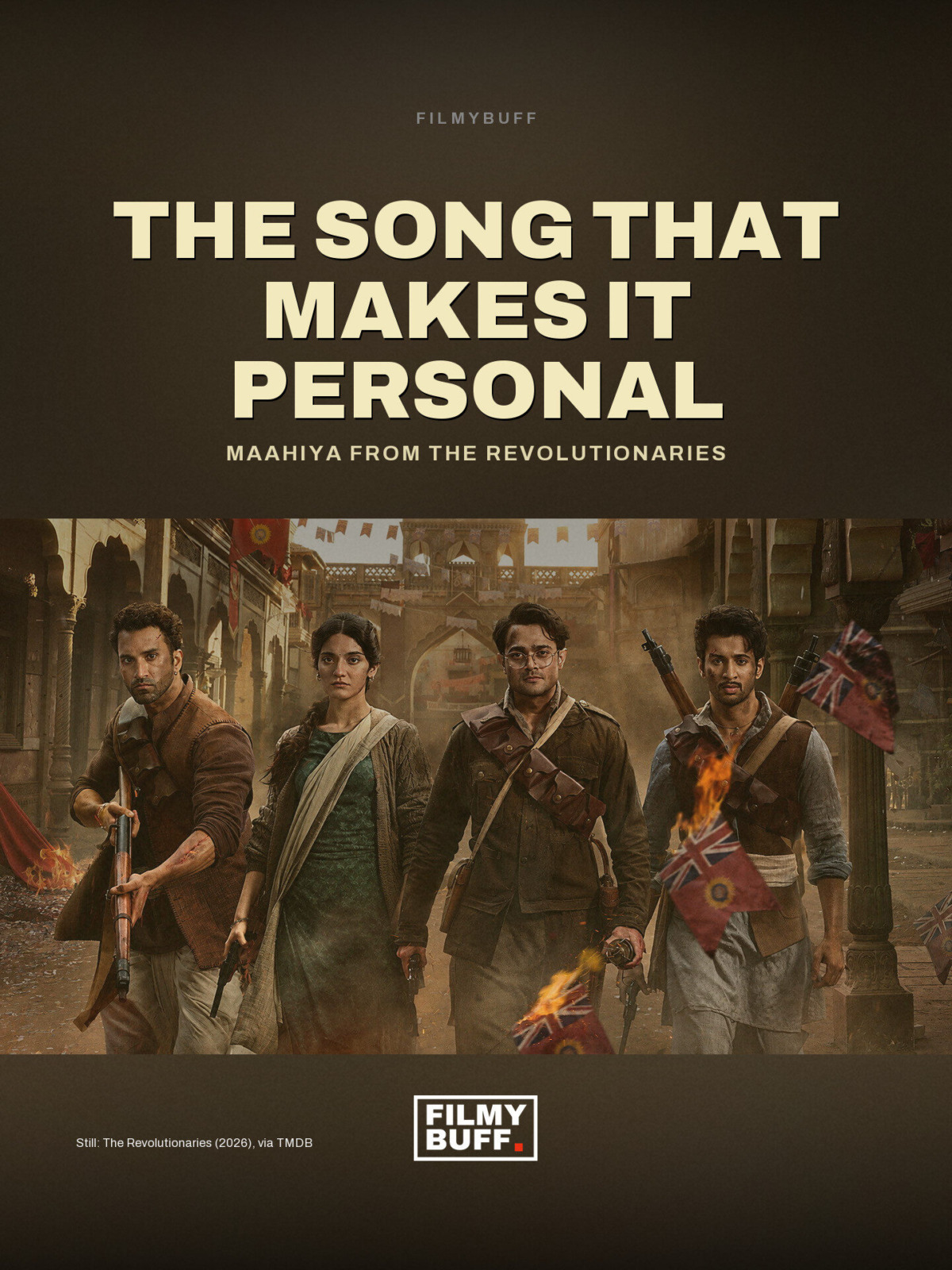
I cannot stop thinking about how much this tiny song is doing for a film called The Revolutionaries.
1. The setup: where the scene sits in the film and what is at stake
This is the moment the film exhales. Until now, the energy has been in the planning rooms and the public stakes of a movement; Maahiya pulls the camera into a two-hander between Rohit Saraf and Pratibha Ranta. The stakes are not a slogan here. They are whether two people can keep something soft alive while the world around them hardens.
2. The turn: the beat where the scene changes gear, and how the film gets there
The song opens like a tease: glances, distance, the chase. The turn arrives when the rhythm section drops out as the chorus peaks. Instead of getting bigger, the scene gets more contained. The characters stop moving toward each other and simply look, which is a far more dangerous decision. The film earns it by building the first minute around withheld touch.
3. The line: the line or the moment people quote, and why it lands
It is still “Maahiya.” The word is the hook, the address and the argument. It lands because the singing treats it as a full sentence: a name that carries more than the verses can say. The writing is smart enough to get out of the way, and Akashdeep’s arrangement leaves a beat of silence before the final repetition, so the word arrives like an answer rather than a chorus.
4. The performance: what the actor or actors do, precisely, that a lesser scene would not
Rohit Saraf’s best choice is restraint. In the tight close-up, his hands stay still, and the feeling sits behind his eyes instead of being performed outward. Pratibha Ranta delays her smile by a half-beat, and that small hesitation changes everything: it reads as recognition, not a rehearsed reaction. A lesser scene would let both of them rush the emotion.
5. The craft: the staging, the cut, the music, the sound, the camera, whichever carries it, with one specific choice named for each you mention
The staging keeps them on opposite sides of a doorway, so the frame itself is about the gap between them. The cut holds on Ranta’s face for an extra beat after his line, trusting her reaction to finish the thought. The music drops percussion at the first chorus and replaces it with strings and the two voices. The sound pulls the room tone down so Tushar Joshi and Neeti Mohan feel close enough to hear breathing. The camera’s slow push-in during the second antara narrows the world until only the two of them exist.
6. Why it travels: why this scene is the one people share, decades or days later
Because it does not need the plot. A viewer who has not seen the film can still feel what is at stake. It gives fans a lead moment, a lyric to quote and a visual chemistry that works in a loop. And for a film about big ideas, this is the small, romantic proof that the revolution would actually be worth it.
Watch the original: T-Series on YouTube. Shown for review and comment; the rights stay with the makers.