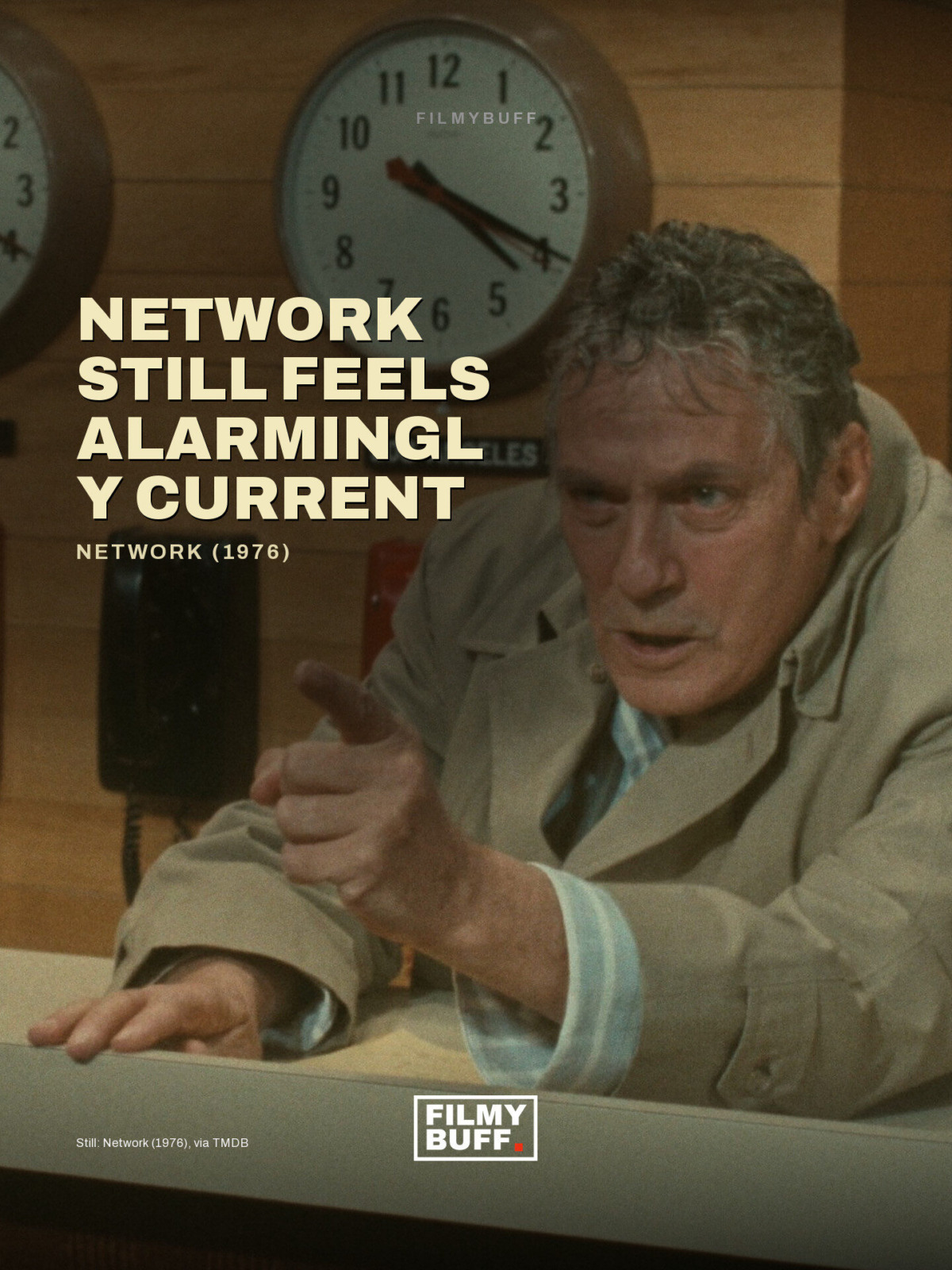
Fifty years on, Sidney Lumet and Paddy Chayefsky’s Network still feels like a bulletin from our own ratings-obsessed moment. The 1976 American satirical black comedy drama follows UBS news anchor Howard Beale, whose on-air breakdown becomes a surprise hit. Here are eight things you didn’t know about the making of a film that knows us too well.
A live death haunted the script
Network came only two years after reporter Christine Chubbuck shot herself on camera as stunned viewers watched on July 15, 1974. Chayefsky used the idea of a live death as the film’s terminating focal point, though Dave Itzkoff notes whether he was inspired by the case remains unclear. A later Beale line referencing “that girl in Florida” was removed.
TV executives barely watched TV
Before starting his screenplay, Chayefsky visited network TV offices and was surprised to learn that television executives did not watch much television. “The programs they put on ‘had to’ be bad, had to be something they wouldn’t watch,” he remarked. “Imagine having to work like that all your life.”
He started out writing a comedy
Chayefsky had intended a comedy, but while writing during Watergate and the Vietnam War he concluded that American audiences were angry and wanted angry shows. He aimed his frustration at television, which he called “an indestructible and terrifying giant that is stronger than the government,” and delivered a dark satire about an unstable news anchor, a broadcasting company and a willing public.
Beale was almost a screen legend
For Howard Beale, Chayefsky jotted down Henry Fonda, Cary Grant, James Stewart and Paul Newman. He wrote to Newman that “You and a very small handful of other actors are the only ones I can think of with the range for this part.” Lumet wanted Fonda, but Fonda declined, finding the role too “hysterical” for his taste.
Even real news anchors were considered
Early consideration was given to real-life newscasters Walter Cronkite and John Chancellor, but neither was open to the idea; both appear during the opening scene through stock footage. George C. Scott, Glenn Ford and William Holden reportedly also turned down the chance to play Beale, with Holden playing Max Schumacher instead.
Finch paid his way to prove himself
Producers were wary that Peter Finch, an Australian, could not sound authentically American, and demanded an audition. Finch reportedly responded, “Bugger pride. Put the script in the mail.” He paid his own fare to New York, listened to American newscasters and taped himself reading The New York Times and the Herald Tribune.
Holden and Dunaway were a risky pairing
Holden and Dunaway had sparred during their earlier co-starring stint in The Towering Inferno. According to biographer Bob Thomas, Holden was incensed by Dunaway leaving him waiting while she attended to her hair, makeup and phone calls. After a two-hour wait, he reportedly pushed her against a wall and snapped, “You do that to me once more, and I’ll push you through that wall!”
The camera becomes a victim of TV
Lumet and cinematographer Owen Roizman worked out a lighting scheme that would, in Lumet’s words, “corrupt the camera.” The film started with a nearly naturalistic look, then grew more rigid and artificial. The next-to-final scene is lit like a commercial, and Lumet said the camera had also become a victim of television.
Which of these behind-the-scenes details caught you off guard? Tell us your favourite Network fact.
Facts from Wikipedia: Network (1976 film), available under CC BY-SA 4.0.
Film images from TMDB. This product uses the TMDB API but is not endorsed or certified by TMDB.