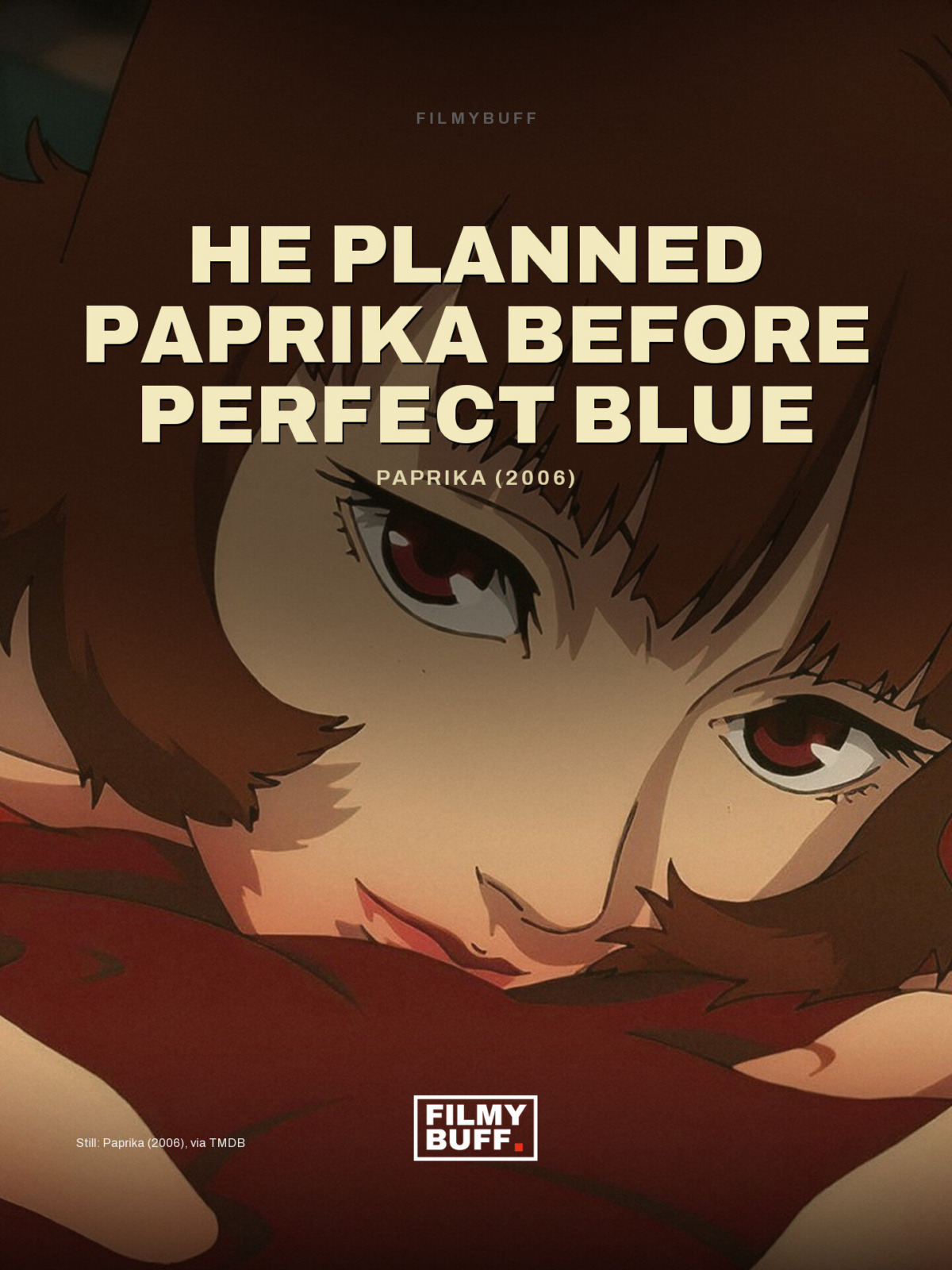
Paprika turns 20 this week, and its dream-parade set piece remains a landmark in animated cinema. Satoshi Kon’s surrealist science-fiction psychological thriller has never really left the conversation, but the anniversary is a good excuse to look at how its most famous images were built.
He dreamed of Paprika before Perfect Blue
After finishing Perfect Blue, Kon planned to make Paprika next, but the project collapsed when Rex Entertainment went bankrupt. The idea was in his mind as early as 1998. His attempts to depict the ambiguities and shaky boundaries between illusion and reality in Perfect Blue and Millennium Actress were, by his own account, because he wanted to visually portray a dynamic like the novel Paprika. When Yasutaka Tsutsui gave permission, Kon said he felt as if he had realized what he had always imagined.
The novel was too voluminous for one film
Kon didn’t change the fundamental parts of Yasutaka Tsutsui’s novel, but he did change some parts to fit the movie. He thought the original was too voluminous for a single film, and that over ten years had passed since publication, with many creators already embodying its ideas. So he made the original into a simple form and then incorporated ideas from the original and Tsutsui’s other works.
Familiar voices kept the dream parade moving
Kon believed the charm of the original lay in the dream scenes, and that the film would only be complete if the dream world was portrayed in rich detail. In visual works, explanation would hinder the flow of dream images. So, in contrast to his previous film, he cast voice actors who were well known for voice acting and whom he deemed to fit the characters. The budget was approximately 300 million yen.
Painting fiction and reality as the same thing
Kon rarely traced real scenes. He wanted his pictures to be more abstract than realistic, so that they would ‘look like that.’ For Kon, fiction and reality were not opposing concepts; both were homogeneous ‘painted things,’ separated only by what is drawn. In Paprika, the dream is a distorted reality reflecting the dreamer’s unconscious desires, and the trick is to move between dream and reality by adding or correcting distortions at the level of the picture.
Cinema hides inside the dream
Paprika tells Detective Toshimi Konakawa that the scenes in his dreams each correspond to genres of movies. The film uses cinema imagery in many of his dream segments because he used to love films and had been in the process of making one with a past friend. Kon’s own films are quietly on display too, including Perfect Blue.
The world caught up with the dream
On Rotten Tomatoes, 87% of 95 reviews are positive, with an average rating of 7.4/10. The consensus reads: ‘Following its own brand of logic, Paprika is an eye-opening mind trip that is difficult to follow but never fails to dazzle.’ Paprika won the Best Feature Length Theatrical Anime Award at the sixth-annual Tokyo Anime Awards during the 2007 Tokyo International Anime Fair. The film grossed $882,267 in the United States and $944,915 outside Japan as of 2007, for a total of $2,506,128 at the box office.
A Vocaloid voice inside the parade
The soundtrack, released on 23 November 2006 under the TESLAKITE label, was composed by Susumu Hirasawa. It is notable for being one of the first film scores to use Vocaloid, with Lola as the ‘voicebank.’ It was also the last of Hirasawa’s albums where an Amiga computer was used for composition, with all MIDI sequenced through an Amiga 4000 running Bars n Pipes.
What’s the Paprika detail you always save—the parade, the score, or the fact that Kon carried it for years? Tell us your favourite.
Facts from Wikipedia: Paprika (2006 film), available under CC BY-SA 4.0.
Film images from TMDB. This product uses the TMDB API but is not endorsed or certified by TMDB.