The setup
By the time the title song lands, the palace has accepted its prince and the film has already established its fairy-tale stakes: a fractured family, a kingdom watching, and a man playing a role everyone needs to believe. The song is the payoff—a full-hearted homecoming, not a plot scene but a release valve. I watch it with the relief that the film finally gets to be what it promised: a big, pretty, Diwali-card spectacle.
The turn
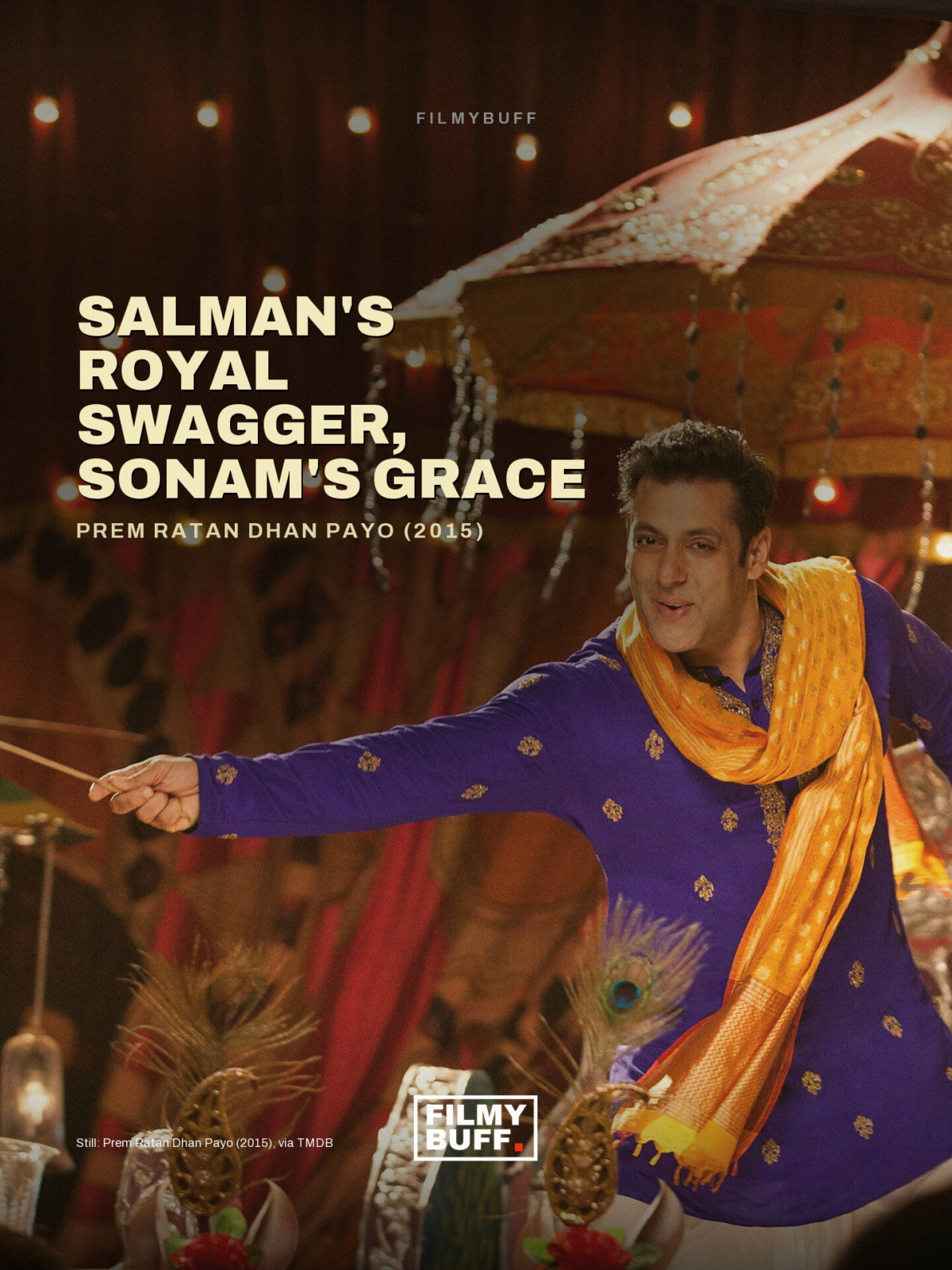
The song begins as a courtly welcome: measured steps, symmetrical frames, Salman waving like a prince accepting devotion. Then the rhythm opens up. The turn comes when the chorus hits and Salman throws his arms wide—not a dancer’s move so much as a mass-audience embrace—and the choreography stops being formal and becomes a celebration. The film gets there by holding the verse at mid-tempo, letting the shehnai and strings circle, then dropping the dhol on the hook.
The line
It has to be the title phrase itself, “Prem Ratan Dhan Payo,” repeated until it stops being a lyric and starts being a blessing. The line lands because it is pitched as a gift: a treasure of love found, which is exactly what the scene is selling. Sonam mouths it with a small, knowing smile, while Salman delivers it with straight-faced ease, and the repetition does the earworm work.
The performance
Salman’s performance is mostly stillness: he doesn’t chase the camera, he lets it come to him. His royal act works because he looks comfortable in the heavy sherwani, his shoulders relaxed, his wave economical. Sonam does the scene’s subtle acting—her eyes keep glancing down and away, so the elegance reads as deference rather than display. A lesser film would make both of them perform “grandeur”; here they perform ease, and the palace does the heavy lifting.
The craft
The staging is built around scale: the long palace corridor, the symmetrical arches, the extras placed like ornaments rather than people. One specific camera choice carries it: the dolly back as Salman walks forward, keeping the distance constant so he never speeds up and the palace seems endless behind him. The cut holds on Sonam’s twirl for a full musical bar before moving, letting her ghagra flare. In the mix, the dhol stays low under the verse and the shehnai melody peaks on the hook, so the chorus feels earned rather than forced. The music does as much as the actors: the hook is lifted by a key change that makes the final minute feel like an arrival.
Why it travels
This scene travels because it is shareable Diwali in four and a half minutes. It gives fans Salman in his most royal register, Sonam in full glamour, a melody that works as a status update, and visuals bright enough to survive a phone screen. People don’t share it as a scene; they share it as a mood—celebratory, a little grand, and completely unembarrassed about it.
Watch the original: T-Series on YouTube. Shown for review and comment; the rights stay with the makers.