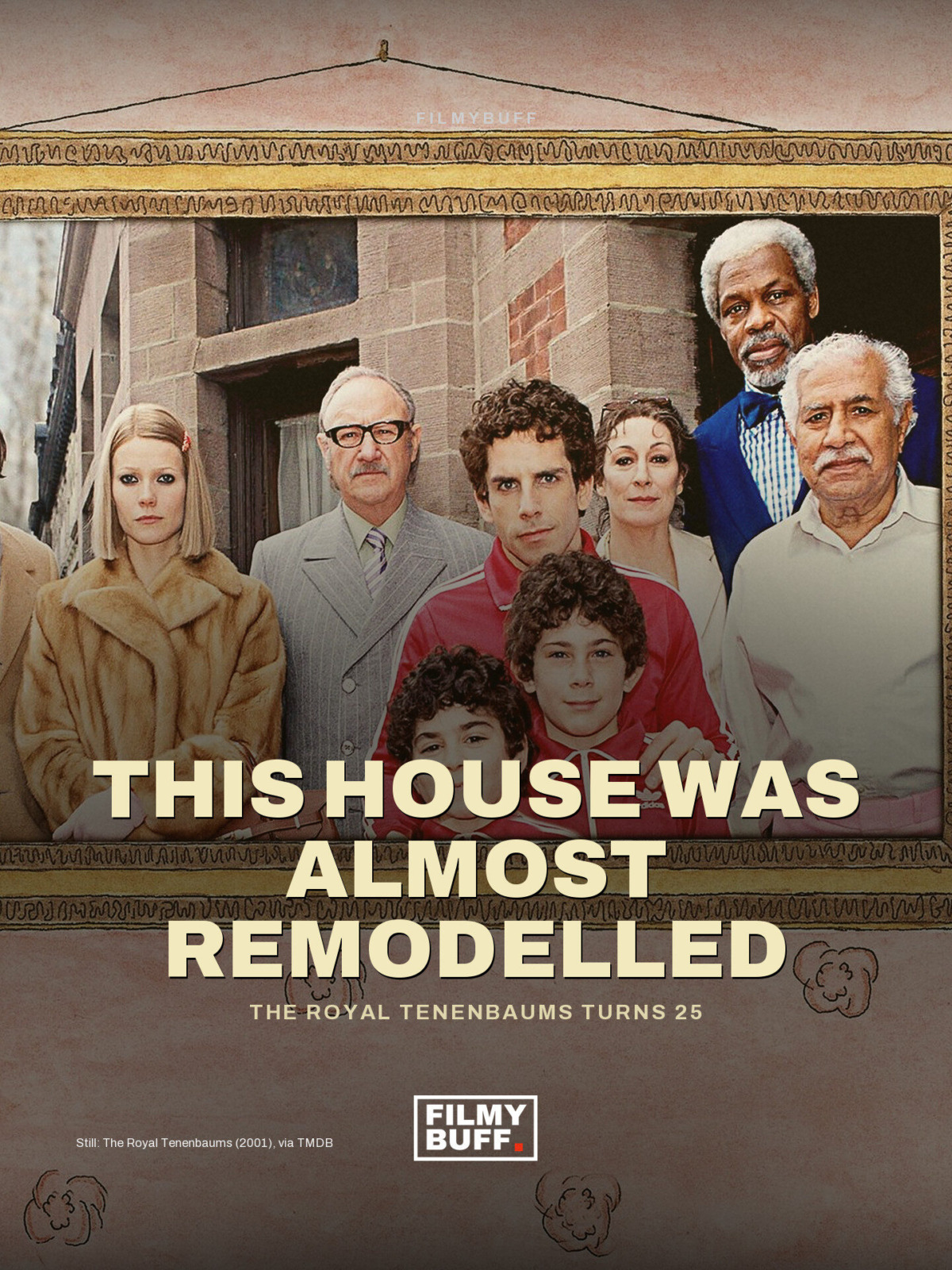
The Royal Tenenbaums turns 25 this week, and Wes Anderson’s storybook New York still feels like a world built by hand. The film gathered an ensemble cast, but its lasting pull comes from tiny, obsessive choices: a real Harlem house, a hidden city, a set of inked mice. Here, fact by fact, is how Anderson and his collaborators made it.
Written for Gene Hackman against his wishes
Gene Hackman was Anderson’s choice for Royal Tenenbaum, but the actor hesitated and had to be persuaded by his agent. Anderson put it plainly: “It was written for him against his wishes.” While Hackman delayed, Michael Caine and, according to rumour, Gene Wilder were considered. Bill Murray later remembered that Hackman was “really rough on Wes,” and that he would “step in there and just try to defend my friend.”
Anjelica Huston’s hair caught fire
During young Margot’s birthday scene in the opening, Huston’s hair caught fire from a birthday candle. Anderson credited Kumar Pallana with extinguishing the blaze before Huston was seriously injured. Anderson also gave Huston photographs of his mother, who, like Etheline, was an archaeologist. Huston finally asked, “Wes, am I playing your mother?” Anderson said no.
The slap was real on day one
On the first day, Hackman and Huston appeared in a scene together, and Huston had to slap him. Later she said the slap was real: “I saw the imprint of my hand on his cheek and I thought, he’s going to kill me.” Anderson and Huston had a tense relationship with Hackman, who was not always amiable on set.
Around 250 sets hid New York
Around 250 sets were employed during photography. Art director Carl Sprague said the crew avoided sites that would identify New York City, and even altered street signs. The Waldorf-Astoria was used for the hotel scenes, Central Park Zoo stood in for a rain forest, a United States Navy training ship represented Richie’s ship, and the crew added 10,000 square feet of AstroTurf at Forest Hills Stadium for Richie’s tennis match.
The animal details were handmade
Anderson said that the film’s dalmatian mice that populate the house were created by crew adding spots with a Sharpie marker. The bird used for Mordecai was caught by a citizen of New Jersey, who demanded a price for its return; it was replaced instead by one more white in colour.
The screenplay took two years
Wilson and Anderson completed the screenplay in two years, needing an extended period because of the film’s complexity. Anderson drew on Louis Malle, Orson Welles’s The Magnificent Ambersons, and J. D. Salinger’s Franny and Zooey, whose precocious Glass children shaped the child-prodigy material. E. L. Konigsburg’s book inspired the museum section.
The storybook house was almost remodelled
For his “quintessential New York story,” Anderson went location scouting in May 2000, spotted the house at 339 Convent Avenue and admired what he described as its “storybook quality.” Owner Willie Woods was planning to remodel it, but agreed to delay the project for six months so principal photography could take place. The house is near Sugar Hill in the Hamilton Heights section of Harlem.
That house, like the film around it, was almost changed before the cameras arrived. Which piece of Tenenbaums trivia do you still catch on rewatch?
Facts from Wikipedia: The Royal Tenenbaums, available under CC BY-SA 4.0.
Film images from TMDB. This product uses the TMDB API but is not endorsed or certified by TMDB.