The setup
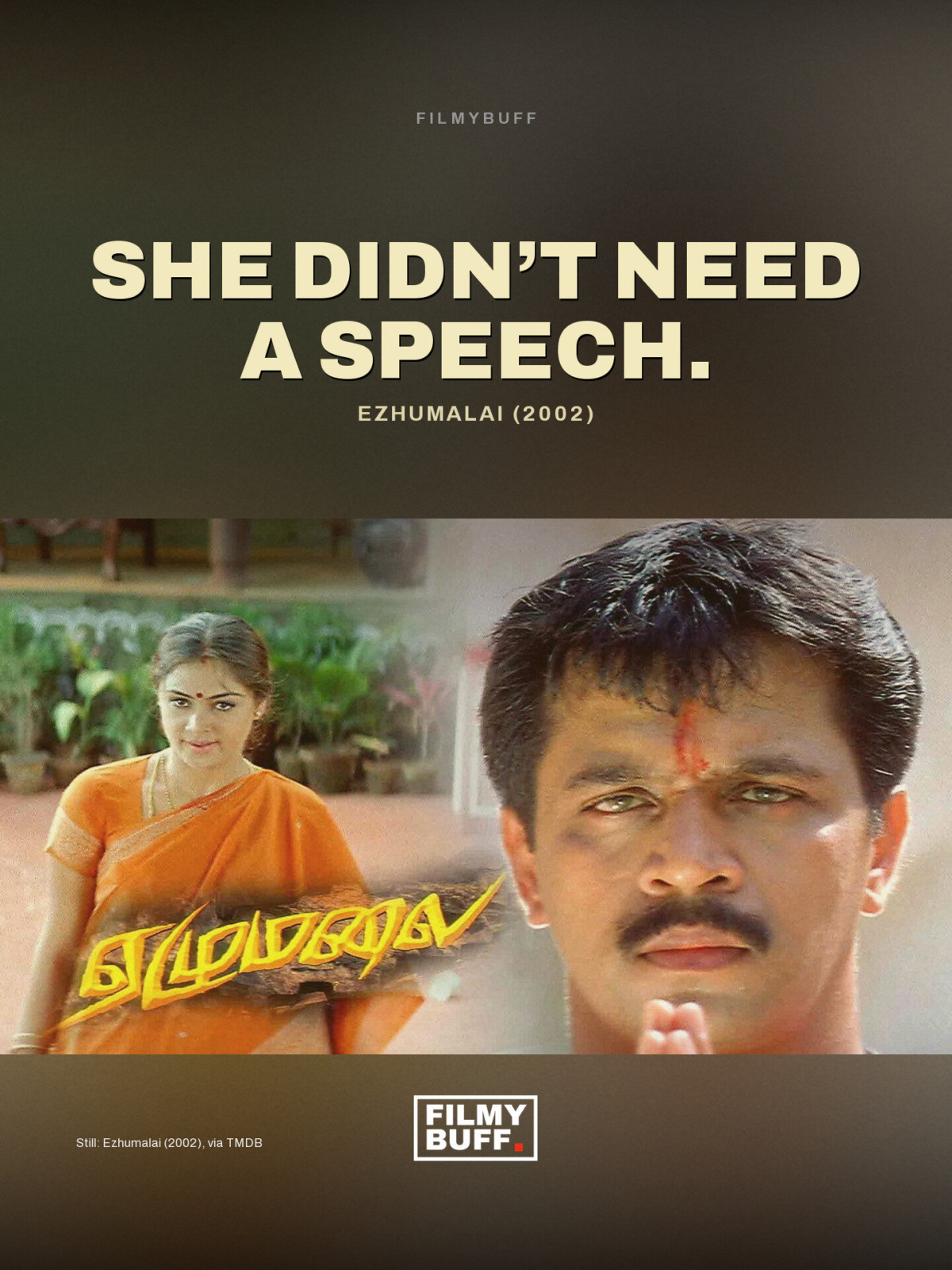
I love this scene because it trusts an actor to carry a whole room. By this point, Ezhumalai has spent the film being underestimated—by the household, by rivals, by people who mistake his silence for weakness. The family has gathered, a provocation lands, and the room expects Simran’s character to stay seated. The stakes are not just his pride, but whether she will let the room rewrite who he is.
The turn
Before she stands, the camera is loose, the room is noisy, and she is part of the seated group. The turn arrives with the physical act of rising: the frame tightens around her, the chatter drops, and the film refuses to cut away. It is a gear change from argument to verdict, and the silence becomes her stage.
The line
The moment people quote is not a long speech. She says his name—Ezhumalai—like it is the only argument needed. The writing gives her no clutter; the line is short, and Simran lands it without raising her voice. A beat of silence, then the name, then the room realizes the conversation is over. It lands because the timing does the work.
The performance
Simran doesn’t point or pace. She stands very still and lets her eyes move from one face to another, which makes the defense feel earned rather than theatrical. A lesser scene would give her a screaming monologue; she instead uses a controlled pause before she speaks, which reads as both anger and dignity. Arjun doesn’t jump in to save the moment; he watches her, which keeps the focus exactly where it should be. There is no big gesture, and that is the point.
The craft
The staging places Simran in the center of the frame with the accusers on the left, so the room’s power balance flips visually before she says a word. The cut is just as deliberate: reaction shots arrive only after she finishes, never over her lines. On the soundtrack, the score drops out and the ambient room noise fades, leaving her voice and a faint rustle of fabric as the whole texture. Even the rustle is a choice; it makes a drawing-room argument feel like a set piece.
Why it travels
For me, this scene travels because it is a release valve. It takes a familiar domestic tension—someone disrespecting a spouse—and turns it into a small, clear victory. Decades later, it still gets shared as a Simran moment, but it works because the film gives her the frame, the silence, and the last word all at once. You don’t remember every line in Ezhumalai; you remember her standing up.
Watch the original: Sun NXT Free Movies on YouTube. Shown for review and comment; the rights stay with the makers.